


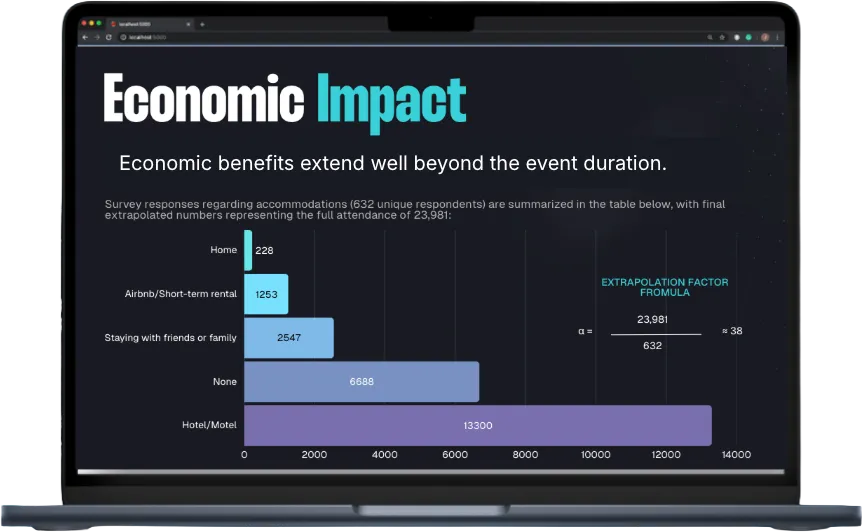





The room is quieter than you expected. There's a slide on the screen showing $2.4 million in estimated local economic impact. The council members are looking at you, not the slide. You've spent weeks building this report. You know every headline number. Then a council member leans forward and asks four words: "How do you know that?"
The question hangs in the air. You reach for the methodology. You mention the multiplier, the hotel pickup numbers, the post-event survey. But the survey had a 17% response rate. The multiplier came from a statewide model. The hotel numbers were self-reported by two properties three weeks after the event. The room recalibrates. The vote you came here to win starts slipping.
That moment is what most economic impact reports are not built to survive. Not because the event wasn't worth it, but because the data behind the report was never collected in a way that could hold up to a direct question. Here's why that keeps happening, and what it looks like when it doesn't.
Executive Summary:
- Fewer than 40% of city council members trust economic impact reports from event organizers, according to a 2023 National Association of Sports Commissions survey (the most recent available).
- Standard reports fail because post-event survey response rates fall below 20%, multipliers are borrowed from statewide models, and attendance figures mix local and out-of-market visitors.
- Defensible data starts with actual hotel room night totals from contracted blocks and verified registration records, not regional averages.
- A single challenged number in a council chamber can derail venue renewals and make every future funding request harder to advance.
- Fastbreak Pulse can generate reports grounded in verified attendance, certified room night totals, and event-specific spend data, giving you numbers you can defend on the spot.
Why City Councils Have Stopped Believing Economic Impact Numbers

City councils have heard the pitch before. A sports tournament comes to town, an economic impact report lands on the dais, and the numbers look impressive. Millions in visitor spending. Hundreds of hotel nights. A multiplier effect that promises ripple benefits across local businesses. Yet the vote still stalls, the funding gets cut, or the conversation quietly dies.
The problem is credibility. After years of inflated projections from consultants and event promoters, local officials have grown deeply skeptical of economic impact numbers. According to a 2023 survey by the National Association of Sports Commissions (the most recent available), fewer than 40% of city council members trusted economic impact reports produced by event organizers. The methodology behind many of these reports relies on multiplier assumptions that academics have long questioned, and councils know it.
What Makes the Numbers So Hard to Trust
Three patterns have eroded confidence in standard economic impact reporting:
- Multiplier inflation: Many reports apply regional multipliers that assume every dollar spent by a visiting athlete family circulates through the local economy multiple times. These figures are frequently borrowed from unrelated industries or outdated models, making the final totals impossible to verify.
- Attribution gaps: Reports rarely distinguish between spending that happened because of the event and spending that would have occurred anyway. A hotel block filled by out-of-state families is genuine new economic activity. A local family eating at a restaurant near the venue is not.
- No post-event accountability: Event organizers submit projections, collect their permits or subsidies, and move on. There is rarely a follow-up report showing what actually happened versus what was promised, and that gap makes it harder for sports commissions to secure event funding in future cycles.
That pattern, repeated often enough, turns a room of potential allies into skeptics before you've said a word.
How Traditional Economic Impact Reports Are Built
Most economic impact reports follow a well-worn formula. A city hosts a tournament, and someone later tallies up hotel nights, restaurant tabs, and retail spending to produce a headline number. That number gets packaged into a PDF and presented to city council as proof the event was worth hosting.
There is a timing problem that runs even deeper than the methodology. Most cities that commission formal economic impact studies wait months for results. The research firm collects post-event data, processes the surveys, runs the multiplier models, and delivers a polished PDF long after the event closes. By then, the budget cycle that needed those numbers has already moved on. The council vote happened in November. The venue renewal decision landed in December. The commissioned study shows up in February, when the only thing it can do is confirm a decision the city already made without it.
The problem is in how those numbers get collected. Most rely on post-event surveys with low response rates, attendance estimates with wide margins of error, and spending multipliers borrowed from regional economic models that may not reflect local conditions at all. As one analysis of IMPLAN vs. RIMS II model limitations notes, the static nature of these multipliers means they cannot easily account for local economic conditions or recent structural changes.
Where the Data Gaps Appear
The gaps show up in predictable places:
- Survey response rates for post-event economic studies routinely fall below 20%, leaving the majority of actual spending uncaptured and extrapolated instead of measured.
- Report authors frequently lift multiplier models from statewide or national data and apply them to local contexts where hotel inventory, restaurant density, and retail mix look nothing like the broader region, which is a core problem shaping the future of sports event measurement.
- Attendance figures blend local and out-of-market visitors without separating which group actually generated new economic activity for the city.
City councils have seen enough of these reports to know the methodology is shaky. That skepticism is what makes the conversation hard.
Why Multiplier-Based Estimates Collapse Under Scrutiny
Multiplier-based economic impact estimates have a structural problem: they rely on assumptions that are nearly impossible to verify at the local level. The standard approach takes visitor spending, applies a regional economic multiplier (often pulled from an IMPLAN or RIMS II model), and produces a headline number that sounds authoritative. The problem is that city councils and CVB boards have seen this playbook before.
Most multipliers are calibrated for regional or statewide economies, not individual host cities. When an organizer applies a 1.8 or 2.1 multiplier to a weekend tournament and claims $4.2 million in local economic impact (a hypothetical example), a skeptical finance director will ask a simple question: where does the money actually circulate? If teams stay in hotels outside city limits, eat at chains that repatriate revenue, and buy gas on the highway home, the local multiplier effect shrinks considerably. Peer-reviewed research on sports event multipliers has long documented how these estimates shift dramatically depending on methodology and whose assumptions are baked in.
There are three specific points where these reports tend to lose credibility in a council chamber:
- The attendance figures are self-reported, with no independent verification or cross-reference against hotel room-night data or gate counts.
- The spending-per-day assumptions are drawn from national averages instead of observed local behavior, which can overstate actual spend by a wide margin.
- The multiplier itself is applied uniformly, regardless of whether the host economy has the capacity to absorb and recirculate that spending locally, a recurring challenge detailed in any serious youth sports tournament impact measurement guide.
A report built on any one of these weaknesses can be challenged in minutes. A report built on all three rarely survives a budget conversation intact.
| Report Element | Traditional Approach | Defensible Approach |
|---|---|---|
| Attendance figures | Self-reported estimates, no independent verification or cross-reference | Verified registration records showing actual team and participant counts |
| Spending assumptions | National averages not calibrated to local behavior, can overstate spend by a wide margin | Spend estimates calculated from actual participant data tied to the specific event |
| Economic multiplier | Applied uniformly from regional or statewide models regardless of local conditions | Assumptions disclosed openly so reviewers can stress-test the numbers themselves |
| Hotel room nights | Pulled from whatever host properties chose to share, days or weeks after the fact | Certified totals drawn from contracted room blocks with a clear paper trail |
| Post-event accountability | No follow-up report showing what actually happened versus what was projected | Year-over-year comparisons showing growth trends across multiple events |
The Data Collection Problem Sports Tourism Directors Actually Face
After the event wraps, someone from the city council or the CVB wants to know what it was worth. So you pull together hotel receipts, run a spending multiplier, and produce a report that looks authoritative on paper.
The problem is that the data underneath it is thin. Attendance figures come from rough headcounts. Spending estimates come from national averages that were never calibrated to the local market. Hotel pickup numbers come from whatever the host properties chose to share, days or weeks after the fact, and that is a limitation the best sports tourism ROI measurement platforms are designed to solve.
Why the Numbers Fall Apart Under Scrutiny
City councils have seen enough of these reports to know when the math is soft. When a council member asks how the attendance figure was calculated, or why the spending multiplier is three times what a neighboring county reported, you rarely have a good answer ready.
That gap between what the report claims and what the director can actually defend is where economic impact arguments lose their credibility.
What's at Stake When the Numbers Get Challenged
When a city council member questions your attendance numbers mid-presentation, the room changes fast. Suddenly, the economic impact report you spent weeks preparing feels fragile. That moment, the one where a single skeptical question unravels your credibility, is exactly what Fastbreak Pulse is built to prevent.
The stakes here go beyond one meeting. Cities make multi-year infrastructure decisions, venue investments, and tourism budget allocations based on these numbers. If your data gets challenged and you can't defend it on the spot, you risk losing funding approvals, venue access, and the political goodwill that took years to build.
Why Credibility Gaps Are So Costly
You walk into the council chamber with a report built from survey estimates, manual attendance counts, and spending assumptions pulled from regional averages. When council members push back, there's no audit trail to reference.
- Challenged attendance figures can delay or derail venue renewal agreements entirely.
- Disputed economic multipliers cause councils to discount the full report, including figures they never questioned.
- Losing a council's confidence once makes every future funding request harder to advance.
Defensible numbers aren't a nice-to-have. They're the difference between a program that grows and one that stalls waiting for approval it never gets.
What Defensible Economic Impact Data Actually Looks Like

Defensible economic impact data starts with methodology that can survive a skeptical room. City councils and CVBs want more than big numbers. They want to know where those numbers came from and whether they hold up.
The gold standard here is hotel room nights. When you can show actual booking data tied to a specific event, you have a verifiable, auditable foundation, exactly what platforms built to measure sports tourism impact are designed to provide. Contrast that with multiplier-based projections, which assume dollars circulate through a local economy at a fixed rate. Those multipliers are often borrowed from regional models that have nothing to do with the event in question, and experienced council members know it.
What Makes the Data Defensible
A few markers separate credible economic impact data from the kind that gets dismissed:
- The data is event-specific, not modeled from regional averages or national benchmarks pulled out of context.
- Room night counts come from actual housing blocks, not estimates based on registration headcount.
- Spending figures are tied to verifiable sources like hotel receipts, point-of-sale data, or post-event surveys with meaningful response rates.
- The report discloses its assumptions clearly, so reviewers can stress-test the numbers themselves.
When Fastbreak Pulse generates an economic impact report, it pulls from real booking and attendance data connected to the event. That's the difference between a number that holds up and one that gets crossed out before you finish your slide.
How Fastbreak Pulse Gives Sports Tourism Directors Defensible Reports
Fastbreak Pulse is built for sports tourism directors who need to walk into city council meetings with numbers that hold up to scrutiny. The reports it produces are grounded in verified attendance, certified hotel room nights, and spending data drawn from actual event records, not estimates built on generic multipliers.
When you work with Fastbreak Pulse, you can pull reports that include actual team counts, participant headcounts, hotel block utilization, and estimated local spending, all tied directly to a specific event. When a council member asks how you got your numbers, you have a clear answer.
How the Data Gets Collected
The difference between Fastbreak Pulse and a commissioned study goes beyond what the report says. It's when and how the data behind it is gathered. Fastbreak puts ambassadors and a mobile app on the ground at every event, capturing first-party visitor behavior, spending patterns, and attendee sentiment in real time while the event is still running. That data comes from actual participants at your specific event, not from a regional model applied weeks later. For the commission or CVB, there's no survey to design, no vendor to coordinate, and no staff time required. Fastbreak handles the entire data-capture operation.
What Fastbreak Pulse Tracks
The data feeding into each report comes from sources that city officials can cross-reference:
- Verified registration records showing team and participant counts, so attendance figures are not approximations pulled from venue capacity.
- Certified hotel room night totals drawn from contracted room blocks, giving the housing impact a paper trail that generic economic models simply cannot produce.
- Spend estimates calculated from actual participant data instead of regional averages, so the local economic impact figure reflects your specific event, not a composite of similar ones. It's the same approach Florida's Sports Coast uses with Fastbreak Pulse to connect tourism data to community outcomes.
- Geographic origin data showing exactly where attending teams and families traveled from, separating genuine out-of-market visitors from locals, so the report reflects new economic activity the city wouldn't have seen without the event.
- Year-over-year comparisons that let you show growth trends across multiple events, giving council members the longitudinal evidence they need to commit to long-term investment.
The Maryland Sports Commission used Fastbreak Pulse to do exactly this, producing event impact documentation that held up in formal budget reviews. That kind of defensible reporting changes how a council interprets every number on the page.
Final Thoughts on Why Defensible Data Changes Every Council Conversation
The pitch doesn't fail because the event wasn't worth it. It fails because the numbers behind it can't hold up when someone pushes back. Verified room blocks, actual registration counts, and event-specific spend give you something real to point to. If you want to see what that looks like in practice, contact the Fastbreak Pulse team.
FAQ
Why don't economic impact reports convince city councils anymore?
City councils have grown skeptical because most reports rely on unverifiable multiplier assumptions, blend local and out-of-market spending without separating them, and never follow up to show what actually happened versus what was projected. According to a 2023 survey by the National Association of Sports Commissions, fewer than 40% of city council members trusted economic impact reports produced by event organizers, so the credibility gap is real and well-documented.
How does Fastbreak Pulse differ from a consultant-produced economic impact study?
Consultant studies apply regional spending multipliers to estimated attendance and produce projections with no traceable source data. Fastbreak Pulse pulls from verified registration records, certified hotel room-night totals from contracted blocks, and actual participant data tied to a specific event, giving sports tourism directors an audit trail they can reference when a council member asks exactly how the numbers were calculated.
What data does Fastbreak Pulse actually capture to build an economic impact report?
Pulse captures verified team and participant counts from registration records, certified room-night totals from contracted hotel blocks, spending estimates calculated from actual participant data instead of regional averages, and year-over-year comparisons across multiple events. Each data point traces back to a known source, which is what makes the output defensible in a formal budget review.
Should a sports tourism director use Fastbreak Pulse or a traditional consultant study to secure city council funding?
If your goal is securing recurring funding, Pulse is the stronger foundation. Traditional consultant studies can cost several thousand dollars or more and produce projections that experienced council members can challenge in minutes because the methodology relies on unverifiable multipliers. Pulse produces event-specific, first-party data that holds up under scrutiny because it comes from actual bookings and registrations, not modeled estimates.
How do I build an economic impact report that survives a city council budget review?
Start with data that has a clear, traceable source: actual hotel room-night bookings from contracted blocks, verified attendance from registration records, and spending figures tied to real participant behavior instead of national averages. Disclose your assumptions openly so reviewers can stress-test the numbers themselves, and include year-over-year comparisons to show growth trends beyond a single-event snapshot.


