







You probably measure your tournament's success in registrations and revenue. That's table stakes. Youth sports tournament impact measurement asks a harder question, though: what economic and social value did your event actually create for the city, the families, and the athletes who showed up? Attendance tells you how many people walked through the gate. Revenue tells you what they paid to enter. Impact measurement tracks where those families came from, where they stayed, where they ate, how much they spent in the local economy, and whether the experience changed anything for the athletes or the community hosting them. Cities, sponsors, and grant committees don't fund events based on vibes. They fund measurable outcomes. If you can't prove impact, you're leaving money on the table before the first whistle blows.
Executive summary:
- Youth sports tournaments generated $91.8 billion in economic impact in 2021, but most organizers can't prove their value to cities or sponsors.
- Track hotel room nights, verified visitor spending, and geographic origin instead of relying on outdated multipliers that inflate numbers.
- Geolocation data combined with post-event surveys captures real movement patterns and spending, replacing guesswork with transaction records.
- Fastbreak Pulse uses geolocation and first-party surveys to deliver verified impact reports that justify grants and unlock hotel rebates.
What Tournament Impact Measurement Actually Means
Analyzing event revenue, once the dust has settled, is just standard operating procedure. But impact measurement looks beyond your P&L and asks a harder question: what economic and social value did your event create for the city, the families, and the athletes who attended? The key here is to gather hard data that you can present to local vendors, such as hotels, to negotiate better financial terms for future events. But it also allows you to show to cities, sponsors, and even possible grant committees that your event has a demonstrably positive impact on the community. Impact measurement, then, tracks where families came from, where they stayed, where they ate, how much they spent in the local economy, and whether the experience changed anything for the athletes or the community hosting them.
The Economic Case for Measuring Youth Sports Tournaments
Your tournament is an economic engine. In 2021, youth travel sports generated $39.7 billion in direct spending, which rippled into a total economic impact of $91.8 billion. That activity supported 635,000 jobs and created $12.9 billion in tax revenue. On the practical side of attending a tournament, visiting families need hotels, meals, and gas. They fill restaurants and retail shops between games. And their activity tells a story about your event. If you can show 1,200 hotel room nights and $500,000 in visitor spending, you're not asking for funding, you're proving your value.
Core Metrics Every Tournament Organizer Should Track
You probably know that there are a lot of metrics you could gather from an event to show that it had an impact. But when it comes down to proving ROI to local businesses, Convention and Visitor Bureaus (CVBs), and sponsors, you should start with three primary categories: visitor behavior, economic footprint, and participation density.
So what kind of data should you gather in these categories?
First is hotel room nights. This is a primary indicator. It captures out-of-market attendance, which drives real spending. Track total room nights booked, average length of stay, and geographic origin of those bookings. A 200-team tournament pulling 800 room nights from 100+ miles away creates more economic impact than 400 teams from within 30 miles.
Second is direct spending per family. To gather this data, you can survey attendees on lodging, food, retail, and gas. A 20% response rate gives you enough to extrapolate total visitor spending. Given how valuable this data is, you can incentivize respondents with a gift card drawing.
Finally, participation metrics separate growth from churn. Track registration rates, repeat attendance year-over-year, and team dropout between divisions. If registration climbs but repeat teams decline, you're trading loyalty for scale.
And you should just skip social media impressions and app downloads as that data doesn't really tell the story of your event's impact on the community's economy. Of course, if you include sponsor brands in your app, you'll want to gather impression information.
A Note on Hotel Room Night Tracking
Hotel room nights provide the clearest proof of economic impact because they verify out-of-market attendance through real transactions. You can get the hotel data for your event by working with partner hotels to pull rooming list reports showing nightly counts, length of stay, and guest origin by zip code.
But gathering this data to use for future negotiations with partner hotels serves more purpose than telling the story of your event's local economic impact. Having several years' worth of hotel night data at your fingertips can help you negotiate the best rebates for future events.
Traditional vs. Data-Driven Measurement Approaches
Most cities rely on economic multipliers borrowed from generic tourism studies. They take your total registration count, multiply it by an average spend number pulled from a different sport or region, and call it impact. The math is clean. The conclusions are worthless.
Data-driven measurement flips the model. Instead of estimating behavior, you track it:
- Geolocation data shows where visitors traveled from and where they went after games.
- First-party surveys capture what families actually spent on lodging, food, and retail.
- Verified hotel booking reports replace assumptions with transaction records.
When you walk into a grant meeting with verified spending data tied to specific zip codes and confirmed room nights, you're not pitching anymore. You're reporting outcomes that justify the next check.
Geolocation Data and First-Party Survey Methods
For many event organizers, terms like geolocation data and first-party surveys might seem a bit foreign. But understanding how powerful this data can be is critical to building a data-driven case for the true economic and social impact of your youth sports tournament.
- Geolocation data represents specific zipcodes, addresses, and other information about locations. It is often used to represent information about users or consumers. Geolocation data from consumer apps, like taxi bookings or reservations, can track where attendees traveled from and where they visited during your event. You get verified movement patterns, not estimates.
- First-party surveys are surveys that are filled out directly by respondents that you contact. So, surveys filled out by your attendees. These surveys capture what geolocation misses: hotel costs, meals, gas, shopping. The most effective surveys keep it short (five questions max) and offer an incentive, like a raffle entry or next year's discount code.
To truly understand your participants' behavior in your local community, you need both. Geolocation proves origin and travel while surveys quantify spending. Combined, you have verified visitor data and attribution that sponsors and CVBs will pay for.
Measuring Community and Social Impact Beyond Economics
Showing the positive economic impact of your tournament can have a real impact. It can help you negotiate better rates with local businesses and hotels. It can help lower facility costs, such as arena or field use. And it can even help with potential funding sources, like local grants.
In short, economic impact wins the grant, while social impact keeps families coming back. Track participation equity, athlete retention, and community access alongside hotel revenue to create a true picture of your event's impact. For example, you can start with participation rates across income brackets and demographic groups. This will tell you whether your event is serving everyone or just a subset. Think about it this way: if your tournament serves 300 teams but only 5% receive financial aid, you're probably missing families that aren't attending because they are priced out of entry. Keep in mind that the average family spending on youth sports jumped 46% since 2019 to $1,016 per child annually.
Just as it's important to understand which families are participating and how often they come back, it's also a good idea to measure athlete retention year-over-year. Are the same kids returning, or are you churning through new families? Track volunteer hours, coaching pipeline development, and whether families felt the event was worth the cost. Community pride is harder to quantify but drives long-term support. Monitor local media coverage, volunteer recruitment success, and whether host venues want you back.
Creating Verified Impact Reports for Stakeholders
When you operate a youth tournament in your local community, you have a lot of stakeholders, some of whom you may not even realize. Yes, you need to provide reports to partner hotels, participating businesses, sponsors, and even CVBs, but you may also want to make your impact data available to a much wider audience. This will help create a positive community response to your event, attracting more participating teams, volunteers, and businesses who want to be a part of it in future years. So, how do you create a verified impact report?
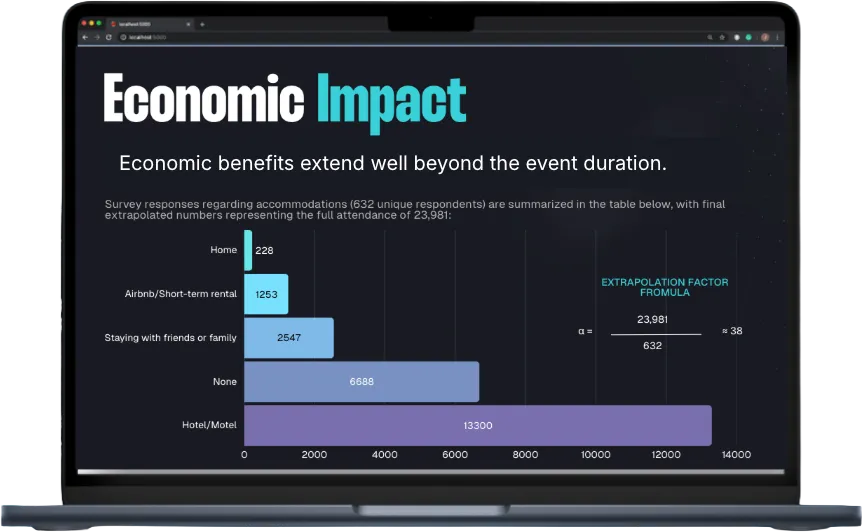
- First, start with a transparent methodology. State your data sources, sample size, and collection period before presenting any numbers. If your survey achieved a 15% response rate, disclose it. If you're extrapolating spending from 200 responses across 1,000 families, show the calculation.
- Next, separate verified metrics from estimates. Hotel room nights from booking reports are verified data. Per-family spending from surveys is an estimate. Label each clearly. Finance departments and city councils trust reports that acknowledge limitations.
- Finally, structure your data around two timeframes. Short-term impact covers direct spending during the event: lodging, dining, and retail. Long-term impact tracks repeat visitation and whether families returned outside the event window.
Common Measurement Mistakes to Avoid
Measuring the true impact of your event in a transparent way can be a bit daunting at first. But once you have a process in place to gather data, analyze it, and generate the reports, it should be pretty easy sailing to tell the story of how your tournament is positively affecting the local economy and community. Until then, though, we've compiled a few gotchas that you should avoid when gathering data and building a report:
- Double-counting inflates numbers and ruins credibility. Count hotel revenue or total visitor spending, not both.
- Outdated multipliers from different sports or regions miss your market. Baseball data from 2015 doesn't reflect 2026 volleyball spending.
- Local families don't generate hotel or meal spend. CVBs fund visitor activity, not hometown participation.
- Without year-over-year tracking, you can't explain why 800 room nights replaced last year's 1,200. Stakeholders need context before they renew.
- Bad data kills partnerships faster than bad brackets.
How Fastbreak AI Provides Accurate Tournament Impact Measurement

Fastbreak Pulse tracks visitor behavior through geolocation data and first-party surveys, capturing origin points, movement patterns, and spending tied to attendees. Fastbreak Travel verifies hotel room nights from booking records, while Fastbreak Ticketing confirms attendance by entry. Data flows between modules without manual exports. You get verified impact reports from transaction records and GPS-confirmed activity. CVBs receive the attribution needed to justify grants. Sponsors see where the dollars went. You collect hotel rebates while proving economic value.
Final Thoughts on Building a Case for Your Tournament
Tournament impact measurement isn't about collecting more data. It's about collecting the right data to prove economic value before the next budget cycle starts. Track hotel nights, visitor origin, and direct spending, and you turn your tournament into an investment case that cities and sponsors can't ignore.
FAQ
How do you separate verified data from estimates in an impact report?
Verified data comes from transaction records like hotel booking reports, ticketing scans, and payment logs. Estimates come from survey responses and extrapolations. Label each metric clearly in your report and show your calculation method so stakeholders understand what's confirmed versus projected.
What response rate do you need from post-event surveys to get reliable spending data?
A 15-20% response rate gives you enough data to extrapolate total visitor spending with reasonable confidence. Keep surveys to a maximum of five questions and offer an incentive, like a raffle entry or discount code, to hit that threshold.
When should you track social impact metrics instead of just economic data?
Track both from the start. Economic impact wins grants and sponsor dollars, but social metrics like athlete retention rates and participation equity prove long-term value to your community and explain why families return year after year.
Why do hotel room nights matter more than total registration numbers?
Hotel room nights verify out-of-market attendance through real transactions, which drives actual visitor spending in the local economy. A tournament with 200 teams pulling 800 room nights from 100+ miles away creates more economic impact than 400 local teams who sleep at home and don't spend on lodging or meals.
Can you use economic multipliers from other sports or regions for your impact report?
No. Multipliers from different sports, time periods, or geographic markets miss your actual market conditions and spending patterns. CVBs and grant committees will reject reports built on borrowed data because they don't reflect what visitors actually spent in their city during your event.


