


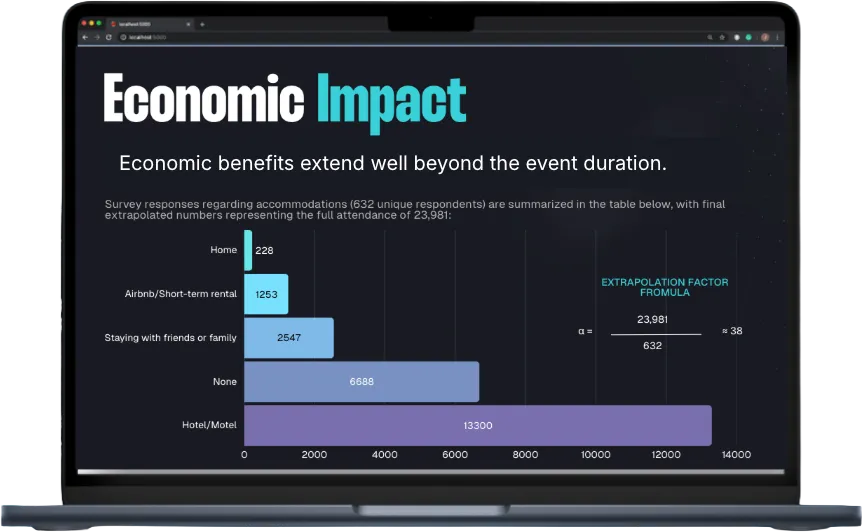





Attendance figures won't provide your next grant application because Convention and Visitor Bureaus (CVBs) stopped accepting economic impact reports built on regional spending averages. They need proof that your visitors actually stayed in local hotels, ate at local restaurants, and generated measurable tax revenue. The shift to verified sports event measurement means layering geolocation signals with first-party survey data to catch every dollar that flows through your event, not simply what happened inside venue gates.
Executive summary:
- Sports event measurement shifted from attendance counts to verified spending data using geolocation and surveys.
- Youth sports tourism generated $39.7B in direct spending, driving an economic impact comparable to that of pro sports.
- Cities demand proof of visitor origin, hotel stays, and spending before approving grants and facility access.
- Mobile apps collect real-time location and spending data while families check schedules and scores.
- Fastbreak AI uses geolocation data and first-party surveys to deliver verified impact reports for CVBs.
How Sports Event Measurement Evolved Beyond Simple Attendance Counts
For decades, sports event measurement meant one thing: counting heads. You tracked ticket sales, maybe gate entries, and called it success if the number went up. But headcount never told you where visitors came from. It didn't capture hotel room nights, restaurant spending, or whether they'd return next year. The data was there, buried in credit card transactions and hotel bookings, but you had no way to connect it back to your event. Unfortunately, cities began competing more aggressively for sports tourism dollars. CVBs needed proof that hosting your event warranted the grants, facility access, and marketing support they provided. A simple attendance figure doesn't win budget battles in city council meetings.
The gap between what you could measure and what stakeholders demanded kept growing. Event operators who stuck with attendance-only metrics found themselves losing bids to competitors who could prove real economic impact with actual data.
Youth Sports Driving the Sports Tourism Economy
Youth sports stopped being a recreational sideshow years ago. In 2021, amateur sports tourism generated $39.7 billion in direct spending, producing a total economic impact of $91.8 billion. That activity supported 635,000 jobs and delivered $12.9 billion in tax revenue. Those numbers put youth tournaments in the same economic weight class as professional sports. A well-run multi-day basketball event with 300 teams generates more hotel room nights than most minor league baseball seasons. The difference is that pro sports run in purpose-built venues with dedicated staff. Youth operators manage temporary operations across borrowed facilities with skeleton crews.
Cities choose events that deliver measurable economic returns. When you show real visitor origin patterns, lodging compliance, and transaction-level spending, you build the case for multi-year partnerships that lock in venue access and funding.
Economic Impact Measurement That Cities Actually Trust
The problem is that cities have really stopped accepting economic impact reports built on multiplier guesswork. When you tell a city council that what every attendee in your youth sports tournament spent based on regional averages, you lose credibility. CVBs need verified visitor spending patterns, not spreadsheet assumptions.
That's because grant funding decisions require defensible numbers. A Destination Marketing Organization (DMO) won't make the decision to allocate $50,000 to your tournament based on a formula that multiplies attendance by an industry average spending rate. They need proof that visitors stayed in local hotels, ate at local restaurants, and generated measurable tax revenue. Real economic impact reports now track origin data, lodging patterns, and transaction-level spending.
When you deliver that level of measurement accuracy, you build the case for the next three years of city partnership and grant funding.
Getting The Data That Will Help You Measure The Impact Of Your Event
Youth sports tournaments have long collected data through surveys and reports from local business partners (such as hotels).
Youth sports tournaments have long collected data through surveys and reports from local business partners (such as hotels). But these aren't enough to understand the true economic impact. In addition, when they aren't done effectively, such as sending surveys out a week or later after an event, you can end up with too little data to adequately tell the story of your event's economic impact. So, how can you make sure the level of granularity you need to build a business case for a grant next year?
- Lean into geolocation data
- Get better post-event surveys
- Use a mobile app
Why Geolocation Data Changed Sports Event Tracking Forever
Geolocation data is one of the key changes that allowed the kind of granularity needed to understand local economic impact. This technology shifted sports event measurement from backward-looking estimates to real-time behavioral tracking. When you collect location signals from mobile devices, you see the actual origin city of every visitor, the hotel where they slept, and the restaurants where they ate. No surveys required to guess travel patterns. The tech works because GPS signals are reliable to within a 4.9-meter radius under open sky, which covers most sports venues perfectly. You can pinpoint whether a family drove 300 miles or flew in from out of state. You know if they stayed downtown or at a budget chain near the highway. You track spending patterns across the entire visit, not simply what happened inside your venue gates.
This matters because CVBs fund events based on verified visitor spending, not attendance figures. When you show a city that 60% of participants traveled more than 100 miles and stayed an average of 2.3 nights, you're speaking the language of economic impact reports that help secure future grants.
Survey Methodologies That Actually Get Responses
Surveys have long been used to gather information from tournament participants. But survey abandonment kills most post-event data collection efforts. You send a 15-question form three days after the tournament ends, and response rates tank below 10%. The data you need to prove economic impact never arrives. Timing decides whether you get responses or get ignored. Send the survey within 24 hours while the event is still fresh. Wait a week, and families have moved on. Response rates hit 20% to 30% when you move fast.
And don't forget about mobile, which is how many people fill out such post-event surveys. If your survey requires horizontal scrolling or takes more than 90 seconds on a phone, you've lost half your audience. Keep it to five questions. Ask about the origin city, lodging location, and total party spending. Skip satisfaction ratings that don't affect your grant application.
Incentives work when they're immediate. A raffle entry for a $500 prize beats a generic thank-you message every time.
Mobile App Integration as the Measurement Infrastructure
Consumer apps turned measurement collection into background infrastructure. When families download an event app for schedules and scores, they're opting into the same system that captures origin data and spending patterns. The app requests location permissions once during onboarding. After that, geolocation tracking runs passively while families check game times and standings. No separate survey emails. No post-event forms that get ignored.
In-app surveys appear at natural moments of engagement. Right after a family checks a bracket update or views a score, a three-question prompt asks about lodging and party size. Response rates jump because the ask happens when users are already active in the app.
Your mobile app operates as that central measurement hub. Parents use it to follow their athlete's schedule. On the back end, it feeds anonymized travel and spending data into reports that CVBs use to base their grant decision.
Combining Data Sources for Complete Event Intelligence to Create Verified Visitor Spending Patterns
No matter how you collect the data, though, you need to combine multiple data sources to create a complete picture of economic impact. Single-method measurement leaves blind spots that kill grant renewals and sponsor deals:
- Attendance tracking misses origin data
- Surveys miss non-responders
- Hotel reports miss families who booked outside your block
Each source tells part of the story, but CVBs fund events based on the complete picture.
Layered intelligence fills every gap. Geolocation data confirms where visitors actually came from. Surveys capture party size and trip spending. Hotel booking systems verify compliance with room-night requirements. When you cross-reference all three, you catch the family that drove 400 miles, stayed with relatives, but spent $800 at local restaurants. That spending counts toward your economic impact total, but a single-source measurement would have missed it. Professional operators run unified data architectures in which registration feeds directly into housing, triggering survey delivery, which flows into impact reports.
The result of this is verifiable visitor spending patterns. Remember that old economic impact reports borrowed spending averages from unrelated events. You'd pull a figure from a regional tourism study and multiply it by your attendance count. The number looked official, but it described someone else's event in a different market with different visitor profiles. That approach fails because your volleyball tournament doesn't mirror last year's baseball championship. Travel distances vary. Lodging preferences shift. Families attending multi-day events spend differently than single-day spectators.
Verified spending patterns layer multiple signals. Geolocation data shows where visitors actually slept and ate. First-party surveys capture party size and total trip spending. When you cross-reference both sources, you catch discrepancies. Maybe geolocation shows 200 families stayed downtown, but surveys reveal average party sizes of four instead of your assumed 2.5. That difference changes your total impact calculation by 60%.
Final Thoughts on the Evolution of Sports Event Tracking
CVBs stopped funding events based on headcount years ago. Modern sports event measurement layers geolocation signals, first-party surveys, and transaction data into economic impact reports that form the foundation of multi-year partnerships. Cities want verified visitor spending, origin patterns, and tax revenue contributions before they write the next check. Build your measurement infrastructure now or watch competitors take your venue dates with better proof of value.
FAQ
How does geolocation data track visitor spending without surveys?
Geolocation data captures GPS signals from mobile devices to track origin cities, hotel locations, and restaurant visits throughout the event. This creates a verified movement pattern that shows actual visitor behavior, which you then cross-reference with transaction data to calculate real spending without relying on post-event survey responses.
What makes cities trust economic impact reports now when they didn't before?
Cities stopped accepting reports based on regional spending multipliers because those numbers reflected different events across markets. Modern reports use verified visitor data that shows actual lodging patterns, origin distances, and transaction-level spending specific to your event, which creates defendable numbers for grant justifications and city council budget meetings.
When should you send post-event surveys to get the highest response rates?
Send surveys within 24 hours while the event is still fresh in participants' minds. Response rates drop from 20-30% to below 10% when you wait a week, because families have already moved on and won't jump to fill out a survey about a tournament that feels like old news.
Why do mobile apps improve measurement accuracy compared to traditional methods?
Apps capture data at natural engagement moments when families are already checking schedules or scores, which eliminates the need for separate survey emails that get ignored. Location permissions run passively in the background, and in-app prompts appear when users are active, creating higher response rates and more complete datasets than traditional post-event outreach.
Can you prove the economic impact if families book hotels outside your official block?
Yes, when you layer geolocation data with survey responses. Geolocation tracking captures where visitors actually stayed regardless of booking source, and surveys confirm party size and spending patterns. This combination catches families who stayed with relatives or booked independent hotels but still generated measurable restaurant and retail spending that counts toward your total impact.


