







The commission that keeps winning grant funding isn't running bigger events than yours. They're just showing up with visitor origin data, verified room nights, and tax revenue tied to actual bookings instead of regional estimates. Your sports tourism funding strategy falls apart when a council member asks how you got the numbers and you have to reference a consultant's multiplier. Here's how first-party data from registration, housing, and ticketing turns event operations into the kind of documentation grant committees can't argue with.
Executive Summary:
- Sports commissions lose funding not from poor events but from unverifiable impact reports.
- Hotel tax revenue from verified room nights directly funds facilities and warrants future grants.
- First-party data from registration and housing beats mobile tracking in grant meetings.
- Fastbreak Pulse captures origin, spending, and room night data as a byproduct of event operations.
Why Most Sports Commissions Lose Funding Despite Strong Events
Sports commissions are losing funding cycles not because their events fail, but because they can't prove the events succeeded. Hotels fill up. Restaurants get slammed. Families spend money across the city for three straight days. And when it's over, the commission submits a report with a multiplier estimate and calls it a day. City councils don't buy that anymore. Grant committees want to see where attendees came from, where they stayed, and what they spent. Without that documentation, successful events can look like guesswork.
So, the commissions that keep securing funding aren't necessarily running better events. They're running better reporting. The gap isn't in event quality. It's in what gets captured, measured, and presented after the final whistle blows.
The Real Cost of Vague Economic Impact Reports

Traditional economic impact studies follow a familiar script. A consultant gets hired, applies a regional spending multiplier, and returns weeks later with a polished report claiming the event generated $4.2 million for the local economy. It sounds authoritative. It rarely is.
The multiplier itself is the core problem. Different consultants use different versions of it, built on different assumptions about visitor spending, residency, and displacement. As research published in The Sport Journal notes, economic impact studies are frequently commissioned by the same sports entrepreneurs who need a favorable result, which makes objectivity a real concern for city councils and grant committees.
City council members have caught on. So have CVB boards. When two similar events in the same market produce wildly different impact figures depending on who ran the study, trust erodes fast. The report stops being evidence and starts being a formality everyone tolerates but nobody believes.
How Hotel Tax Revenue Connects to Grant Approval
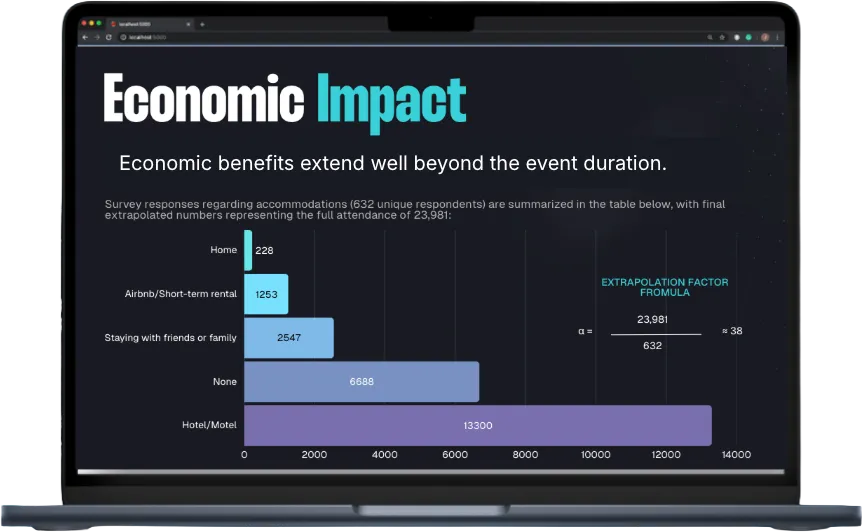
Hotel tax revenue funds sports infrastructure. When visitors book rooms, a percentage flows directly into municipal coffers, and those dollars often finance the very venues and facilities that sports commissions need access to. It's a cycle that only works when the hotel impact can be documented. In 2021, sports-related travel accounted for 66.5 million hotel nights booked by families attending events. That volume of occupancy translates into real tax revenue, and cities know it. So, when a commission can show exactly how many room nights their event generated, they're speaking directly to how tourism development funds get replenished. Vague estimates, though, don't move grant committees. Verified room block data does. Commissions with that documentation make a case for future grants that's hard to argue with.
When Different Stakeholders Need Different Numbers
Different funding stakeholders ask very different questions about the same event:
- A city council member wants to know how much tax revenue the event generated.
- A CVB board wants to know how many out-of-town visitors drove that revenue.
- A hotel partner wants to know how many room nights were booked and whether the block filled.
So, commissions often end up stitching together different data sources for different audiences, and the numbers rarely line up cleanly. That inconsistency creates doubt. When your council report shows 3,200 attendees but your hotel report shows 400 room nights, someone in the room is going to do the math and ask questions you don't want to answer.
Verified first-party data, though, cuts through that problem. When attendance figures, housing data, and visitor origin information all come from the same source, your numbers stay consistent across every conversation:
- The council gets their tax impact story.
- The CVB board gets geographic origin data.
- The hotel partner gets room night verification.
None of those narratives contradict each other because they all pull from the same foundation. That's where defensible numbers actually come from, not from a consultant's formula, but from real event data captured at the source.
The Hotel Partnership Problem Sports Commissions Face
Hotel rebates are one of the most direct ways sports commissions offset event costs. When enough teams book through preferred properties, the commission earns a percentage back, which can fund venue fees, staffing, or go directly toward next year's event budget. The problem, unfortunately, is compliance. When teams book outside the preferred block, that rebate disappears. The San Diego Sports Commission experienced this firsthand: they offered tournament organizers several thousand dollars contingent on hotel revenue from preferred properties. When the community bypassed those hotels, the commission pulled the incentive entirely the following year.
That's a funding cycle broken by a compliance gap, not a bad event. Without a system that tracks which teams have booked their required rooms in real time, commissions are left reacting after the damage is already done.
First-Party Data vs. Mobile Location Tracking
Not all data carries the same weight in a grant meeting.
Mobile location tracking, for example, pulls signals from phones in a geographic area and infers who attended your event. It can show general foot traffic patterns, where visitors came from, and where they went afterward. Useful context, but it comes with a catch: city councils can ask how you know those phone signals belong to your attendees and not the shopping center next door. First-party data, on the other hand, doesn't have that problem. When a family registers for your event, you know exactly who they are, where they traveled from, and which hotel they booked. Survey responses collected through the event app add another layer of verified spending behavior.
That difference matters when someone at the council table asks how you got your numbers. Registration data and direct surveys have a clear answer. Location tracking requires explanation. The table below provides an overview of data source, what they capture, and their credibility with different constituents.
| Data Source | What It Captures | Credibility with City Councils | Credibility with CVB Boards |
|---|---|---|---|
| Traditional Consultant Study | Estimates based on regional spending multipliers applied to attendance estimates, indirect and induced economic effects | Low to moderate - councils question methodology and objectivity when consultant is hired by event organizer | Moderate - familiar format but increasingly questioned for accuracy |
| Mobile Location Tracking | Foot traffic patterns, geographic origin signals, movement before and after event within geographic area | Moderate - requires explanation of how attendees are separated from ambient traffic and how privacy is maintained | Moderate to high - provides useful origin data but lacks verified spending information |
| Hotel Block Reporting Only | Room nights booked through official blocks, hotel partner compliance, rebate revenue calculations | Moderate - shows real hotel tax impact but misses full economic picture including out-of-block bookings | High for hotel impact, low for full tourism impact |
| First-Party Event Data (Registration, Housing, Ticketing) | Verified attendee counts with origin data, actual room night bookings across all properties, direct spending surveys, tax revenue tied to real transactions | High - every figure traces back to known event participants with clear methodology | High - provides geographic origin, verified visitor counts, and hotel impact in one consistent data set |
What City Councils Actually Want to See Before Writing Checks
Grant committees have moved past accepting polished estimates. What they want now is documentation that holds up when a skeptical council member starts asking follow-up questions. The specific asks tend to follow a pattern:
- Verified visitor counts with out-of-town percentage breakdowns, so committees can separate genuine tourism draw from local attendance
- Actual hotel bookings tied to the event, not regional estimates that could apply to any weekend
- Tax revenue figures generated from room nights and local spending, presented in a way that connects directly back to the event
- Geographic origin data showing where attendees traveled from, broken down by distance or region
That last point matters more than most commissions realize. An event drawing visitors from three states tells a very different funding story than one that's mostly local. CVBs use that origin data to base their grant decisions on genuine tourism impact, not simply on attendance volume.
The standard has changed. Auditable, real-time data is what gets a commission back to the table next year.
How Fastbreak AI Turns Event Operations Into Funding Documentation

Fastbreak Pulse sits at the end of that checklist and works backward through it. Because registration, housing, and ticketing all run through a single connected system, the economic data commissions need for grant applications gets captured as a byproduct of running the event itself. When a family registers, their origin is recorded. When a team books through the housing portal, that room night is verified against the block. When a ticket is scanned at the gate, attendance is logged in real time. No consultant needed. No multiplier required.
What comes out the other side is a funding report built entirely from first-party data:
- Verified visitor counts tied directly to registration records, not estimates based on team size assumptions.
- Room night totals cross-referenced against actual housing block bookings, giving you defensible figures for hotel partner reporting.
- Geographic origin breakdowns that show exactly where out-of-market visitors traveled from, which strengthens tourism funding strategies.
- Tax revenue estimates connected to real booking data instead of industry averages.
Every figure has a traceable source, which means every figure holds up when a council member asks how you got there.
Final Thoughts on Closing the Gap Between Events and Funding
The events you're running already generate real economic value. The problem is proving it with data that city councils and CVB boards will believe. When you build sports tourism funding strategies around verified event data, your reports stop sounding like estimates and start sounding like receipts. Hotel bookings, visitor origin, tax impact: all of it comes from what you're already capturing through registration and housing. If you want to stop fighting for funding with multiplier estimates, reach out and we'll show you what first-party data can do for your next grant application.
FAQ
How can you prove economic impact without relying on spending multipliers?
First-party data from event registration, housing bookings, and ticket scans provides verified numbers that hold up under scrutiny. When you can show exactly how many out-of-town visitors attended, where they came from, and which hotels they booked, you're presenting documentation instead of estimates.
What specific data points do city councils want to see in grant applications?
City councils typically want verified visitor counts with out-of-town percentages, actual hotel bookings tied to your event, tax revenue figures generated from those room nights, and geographic origin data showing where attendees traveled from. The key is that each figure needs a traceable source.
Why do hotel partnerships break down even when events are successful?
Teams booking outside preferred hotel blocks cause commissions to lose rebate revenue that funds future events. Without real-time tracking of which teams have met their booking requirements, you're left reacting after teams have already booked elsewhere and the rebate opportunity is gone.
How does Fastbreak Pulse capture economic impact data differently than traditional consulting firms?
Fastbreak Pulse captures data as a byproduct of running your event through a connected system. When families register, teams book housing, and tickets get scanned, that information flows into your impact report automatically. No consultant needed to apply multipliers weeks after the event ends.
What makes first-party survey data more credible than mobile location tracking for grant reporting?
When a council member asks how you verified your numbers, registration data and direct surveys have a clear answer: you collected it from known event participants. Mobile location tracking requires explaining how you separated your attendees from ambient foot traffic in the same geographic area.


