







A parent juggling two kids and a folding chair does not want to hunt for a PDF at the gate. That small moment of friction says more about your event than the trophy ceremony does. Mobile-first ticketing for youth sports has moved well past QR codes, and the organizers who get this right are turning their gate into something that actually works for families instead of against them.
Executive Summary:
- According to Grand View Research, digital tickets held 74.3% revenue share in 2025, yet many youth tournaments still run cash boxes and paper wristbands.
- SMS delivery sends tickets directly to a parent's messages app, no account or app download required, and tickets surface automatically at the gate via Apple Wallet or Google Pay.
- Offline scanning loads ticket data to the device before gates open, so dead cell zones at multi-venue tournaments do not stop entry or create lines.
- The FTC's junk fees rule, effective May 12, 2025, requires the price shown first to be the price paid, creating compliance risk for platforms that add fees at checkout.
- Fastbreak AI delivers SMS ticketing, offline scanning, and sponsor branding on every digital pass for multi-venue youth events.
How Sports Ticketing Evolved from Paper to Digital
From paper stubs to barcodes to QR codes, sports ticketing has always moved in step with consumer habits. Each format solved the problems of the one before it: barcodes replaced manual tear-offs and built an audit trail; QR codes replaced duplicate-prone printed barcodes with live database validation.
QR codes became the default through the early 2020s for good reason. Duplication was nearly impossible, and the workflow was familiar enough. But the workflow still had real friction. You had to find the right confirmation email and get the app open before you could even approach the gate, on a phone with enough battery left to cooperate.
The Expectation Gap That QR Codes Created
The real pressure on QR codes has nothing to do with the tech itself. It comes from what families do the other six days of the week. The same parents attending a Saturday youth basketball tournament are tapping contactless payments at coffee shops, pulling up digital boarding passes without searching their inbox, and tracking deliveries in real time.
That context reset what "acceptable" means. Friction that felt normal in 2015 reads as disorganization in 2026. A parent juggling two kids and a folding chair does not want to scroll through a week of emails looking for a PDF (see these online event ticketing tips for how operators are closing that gap). They want a ticket that shows up in a text message and works at the gate without any extra steps.
That widening gap between what QR codes require and what families now expect is where the future of sports ticketing is being built.
Why Legacy Ticketing Systems No Longer Meet Fan and Family Expectations
The gap between pro-grade fan experiences and what youth tournaments actually deliver has been widening for years. Families who tap into an NBA arena on Saturday night show up Sunday morning to a youth tournament expecting the same thing, and get a cash box, paper wristbands, and a volunteer with a highlighter instead.
According to Grand View Research's sports events tickets market report, digital tickets held a 74.3% revenue share in the sports events tickets market in 2025. Consumer preference has already moved. The gap now is between where the market sits and where many youth and amateur events are still operating.
That gap carries real costs for tournament directors. Revenue walks away when someone forgets cash. Gate counts become impossible to verify. Attendance data that sponsors actually want to see simply does not exist. Wristbands fall off by the second game and leave no audit trail behind.
Legacy formats were built for an era when cash was king and smartphones were optional. Neither is true anymore. Families budget for youth sports costs in 2026 the way they budget for any recurring family expense, and they bring the same expectations they have everywhere else in their financial lives.
| Legacy Ticketing (Cash / Paper) | Mobile-First Ticketing (SMS / Digital Wallet) | |
|---|---|---|
| Delivery method | Cash at the gate or printed wristbands | SMS link saves to Apple Wallet or Google Pay instantly |
| Account or app required | No (cash only) | No, no app download or account creation needed |
| Offline capability | Cash works anywhere; no audit trail | Ticket data loads to scanner before gates open; syncs when connectivity returns |
| Audit trail | None: no entry records, no reconciliation | Every scan logged; dashboard shows real-time gate counts by venue |
| Sponsor revenue | Not possible | Sponsor logos and offers embedded directly on each digital pass |
| FTC junk fees compliance | N/A | Final price shown upfront, no hidden fees at checkout |
| Market adoption (2025) | Declining; digital tickets held 74.3% revenue share | 74.3% revenue share; mobile ticketing over 60% of all ticket sales |
The Mobile-First Shift Reshaping Sports Ticket Sales
According to Market Research Future's sports events ticket market report, mobile ticketing accounted for over 60% of all ticket sales in 2025. That number reflects something broader than a format preference. It reflects how people now move through their days.
Smartphone adoption reached the point years ago where carrying a phone is less optional than carrying a wallet. Contactless payments followed. When you can board a flight, pick up a prescription, and pay for parking without touching paper or entering a PIN, the bar for what counts as "easy" at an event gate rises accordingly. Families arriving at a youth tournament on a Saturday morning have already used their phones four times before they find a parking spot.
The mechanics driving this are straightforward. Your phone is already with you, your digital wallet stores tickets without any action on your part, and a push notification tells you if the game time changes. None of that requires searching an inbox or remembering a password. The experience compresses to a single tap, which is exactly what every other consumer interaction in 2026 asks for.
Youth sports operators who still rely on cash at the gate or printed wristbands are not competing against a different ticketing system. They are competing against a behavioral baseline their attendees carry into every other part of their lives.
SMS Delivery, Digital Wallets, and Friction-Free Event Entry
SMS delivery closes the gap that QR codes left open. A parent receives a text, taps the link, and a ticket lands in Apple Wallet or Google Pay. There is no account to create and no app to download. The ticket shows up in their messages app without requiring any search through a week of old emails. If you're weighing options, a comparison of free mobile ticketing services can help narrow the field.
That sequence matters more than it sounds. Families managing two kids across three venues in a single day are not going to pause at the gate to troubleshoot a login screen. The ticket has to be there, ready, without any setup required beforehand. SMS delivery makes that possible because it meets people where they already are: their messages app.
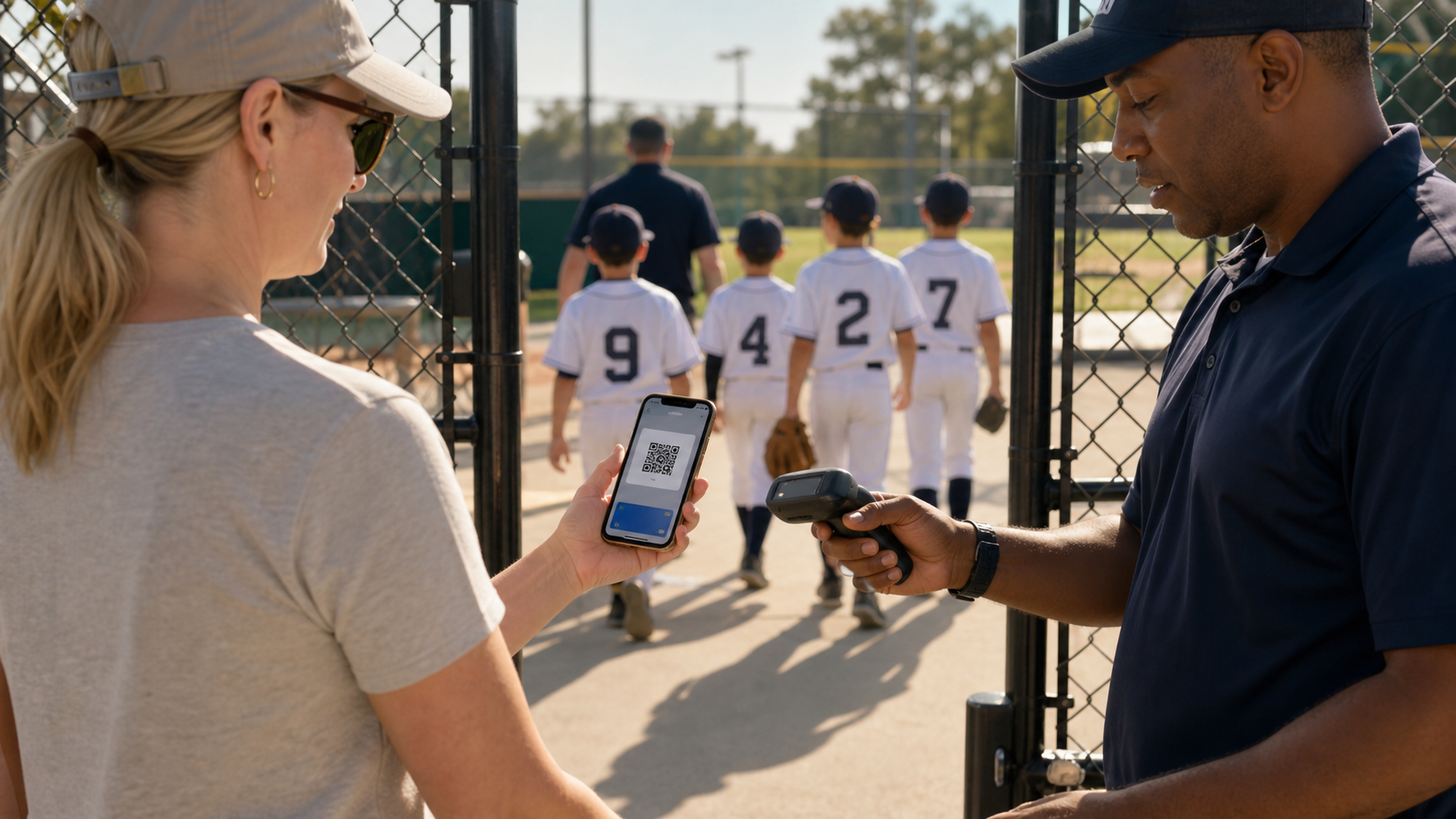
The wallet integration layer compounds the convenience. Once a ticket saves to Apple Wallet or Google Pay, it surfaces automatically on the lock screen when the device detects it is near the venue. No searching required. The phone knows where you are and puts the ticket in front of you at the right moment.
The goal is invisibility. A gate experience that works without friction never becomes a conversation. Families walk in, scan, and the day starts. Buyers who receive a ticket link via text also complete the purchase in the same flow they are already in, instead of getting routed to a separate platform that requires credentials they do not remember creating.
Cashless Payments and Offline Scanning at Multi-Venue Tournaments
Multi-venue youth tournaments are not an NBA arena. A three-day basketball showcase might run across a high school gym, a recreation center, and a church fellowship hall at the same time. Cell service at one of those locations is negotiable. Wi-Fi, if it exists, belongs to the facility and may be locked or overloaded by halftime.
That infrastructure reality is why cashless adoption has moved slower in youth sports than in pro venues. Stadium operators can wire Ethernet to every gate. Tournament directors cannot. If a gate scanner requires a live internet connection to validate tickets, one dead zone means a line, a workaround, or a volunteer with a hand-stamp and a prayer. A deeper look at why tournament gates break down explains the failure points.
How Offline Scanning Changes the Equation
Offline ticket scanning solves that directly. Ticket data loads onto the scanning device before the gates open. At venues with no signal, the scanner validates QR codes locally and logs each entry. Once connectivity returns, everything syncs back to the central dashboard automatically. The gate keeps moving regardless of what the cell towers are doing.
Tap-to-pay acceptance works the same way. A volunteer with a smartphone can take card payments without needing a constant connection, which removes the last practical argument for keeping a cash box on site. Cash creates its own problems: no audit trail, float risk, and reconciliation at the end of a fourteen-hour day. The business case for going cashless at tournaments lays out why the switch pays off. A tap-to-pay flow at every entry point closes those gaps.
The one thing organizers need to think through before going fully cashless is communication. Families who expect to pay at the door with cash need advance notice. A clear message in the pre-event text or registration confirmation does the job. The transition is straightforward once families know what to expect.
How AI and Data Automation Are Changing Ticketing Operations
Gate operations at a youth tournament often run on a volunteer with a phone. One person scanning tickets, another handling walk-up cash, a third trying to answer a parent's question about field locations. When something breaks, there is no operations center to call.
A connected system watches the gate in ways a two-person volunteer crew cannot. It catches entry anomalies as they happen and puts real-time data in front of the organizer so decisions get made during the event, not the morning after. A live dashboard showing gate counts by venue, ticket redemption rates, and walk-up sales pace tells a director whether a venue is hitting capacity before the problem becomes a crowd control issue.
Tiered pricing is a smaller but real revenue lever. Setting a lower early-bird price and a higher day-of price is something any operator can do manually. Automating the transition and adjusting tiers based on current registration volume is not. A connected system handles that without anyone remembering to log in and change a setting at 7 AM on event day.
Fraud reduction is quieter but equally important. Duplicate ticket scans, shared screenshots, and walk-throughs on expired passes are real problems at events running across multiple venues. A comparison of offline ticket scanning platforms for tournaments can help directors choose the right system. Offline-capable scanning that validates against a live dataset prevents the entry that a tired volunteer might wave through on instinct.
The attendee data piece is where the longer-term value sits. Every scan generates a record: when a family arrived, which venue, how they paid. Aggregated across an event, that data tells organizers which gates need more staffing, which sessions drove the highest walk-up demand, and what a sponsor impression at the gate was actually worth. That is information sponsors want and that most operators currently have no way to provide.
Price Transparency and the FTC Junk Fees Rule for Live-Event Tickets
The FTC's Rule on Unfair or Deceptive Fees, effective May 12, 2025, bans hidden live-event ticketing fees and prohibits bait-and-switch pricing. The price a buyer sees first must be the price they pay. No service fees appearing at the final screen. No mandatory add-ons disclosed only at checkout.
For tournament directors using third-party ticketing platforms that historically split base prices from service fees, this is a compliance exposure that did not exist before. If a family sees $8 and pays $11.50, the organizer carrying that platform relationship now carries regulatory risk alongside it. Integrated mobile ticketing that shows a final price upfront removes that structural problem entirely, because there is no separate fee layer to hide.
Ticketing as a Revenue Line, Beyond Entry Management
Most tournament directors think about ticketing once: when they set the gate price. After that, it gets filed under entry management. That framing leaves money on the table.
Digital ticket passes are inventory. A ticket saved to Apple Wallet or Google Pay sits on a parent's phone from purchase through gate scan. Every pass can carry a sponsorship asset on every ticket: a sponsor logo, a promotional offer, or a QR code linking to a brand campaign. Sponsors get guaranteed impressions tied to a real attendee action, and organizers can track redemption rates to prove ROI. That is a sellable asset a cash box at the door never created.
Tiered pricing adds another layer. A Friday evening session and a Sunday championship final are not the same product at the same price. Early-bird windows, day-of walk-up rates, and premium finals pricing are all configurable tiers that capture more revenue without raising baseline costs for families who plan ahead. The organizer sets the rules once; a connected system handles the transitions automatically.
The real-time dashboard ties it together. Knowing at noon on Saturday that walk-up sales at Venue 3 are running 40% ahead of projections lets a director act, whether that means adjusting pricing, alerting staff, or calling a sponsor partner with updated attendance numbers. Static end-of-day reports cannot do that.
Sponsor placement, tiered pricing, and live sales data together turn ticketing from a cost-neutral gate function into a revenue line that compounds across every event a director runs.
Equitable Access and the Digital Divide in Youth Sports Ticketing
Mobile-first ticketing solves real problems for most families. For some, it creates new ones.
According to the Aspen Institute's State of Play 2025 report, the income-based participation gap in youth sports widened to 20.2 percentage points by 2024 (the most recent data available), up from 13.6 points in 2012, with youth sports costs rising 46% since 2019. Families already stretched thin by registration fees, equipment, and travel do not need a ticketing system that adds another layer of friction at the gate.

The practical risks are specific. A parent without a reliable data plan may not receive an SMS ticket in time. A grandparent who drove three hours to watch a grandchild play may not have Apple Wallet configured. A family sharing one prepaid phone across four people may find the ticket inaccessible at the wrong moment. None of these scenarios are hypothetical, and none of them are solved by telling someone to just use their phone.
Organizers going cashless need to build redundancy into their gate workflow as a design decision, not an afterthought. That means accepting printed ticket confirmations alongside digital passes, training volunteers to help families retrieve tickets on site, and communicating payment options clearly in pre-event messaging before anyone leaves their driveway. A small sign at the gate that says "need help?" is not a policy. A volunteer assigned to assist families with access issues is.
The goal of mobile-first ticketing is faster, more equitable access, not a higher bar for entry. Organizers who design their gate experience with their lowest-access attendees in mind end up with a better experience for everyone.
How Fastbreak AI Brings Mobile-First Ticketing to Youth Sports Events
Fastbreak AI Ticketing pulls together everything covered in this article into one mobile-first platform built for multi-venue youth events. Tickets go out via SMS immediately after purchase, and a parent can tap that link to save the ticket to Apple Wallet or Google Pay without creating an account or downloading an app. The ticket surfaces automatically when they arrive at the gate.
At the gate itself, volunteers scan with any smartphone. Tap to Pay handles walk-up purchases on the same device. When cell service drops at a gym across town, offline scanning keeps the line moving and syncs every entry back to the central dashboard once connectivity returns.
Sponsor branding sits directly on each digital ticket pass. Every family who saves a ticket to their wallet carries a brand impression from purchase through gate scan, and organizers can track coupon redemption rates to show partners what that visibility was worth. That is inventory a cash box never produced.
The World Taekwondo Grand Prix used Fastbreak AI Ticketing to deliver smooth, fast entry across a multi-day international championship. International attendees, multiple sessions, and a compressed gate window are exactly the conditions where SMS delivery and offline scanning earn their keep.
For directors who run ticketing alongside Fastbreak Travel's housing rebates and Fastbreak Connect's sponsor activations, revenue potential across all three streams can generate meaningful additional revenue per event without raising team fees.
Final Thoughts on the Future of Sports Ticketing
Ticketing has always moved with consumer habits, and right now those habits are mobile, contactless, and built around the expectation that things just work. The operators who close the gap between what families expect and what they find at the gate are the ones building something worth coming back to. Operators who design their gate with the lowest-access attendees in mind and build real redundancy into the workflow end up with a better experience for everyone. When every scan is treated as a data point worth keeping, the value compounds across events in ways a paper stub never could. Contact the Fastbreak team to see how mobile-first ticketing fits your event setup.
FAQ
What's the difference between SMS-based ticketing and QR code ticketing for youth sports events?
SMS ticketing sends a ticket directly to a buyer's phone as a text message, which lands in Apple Wallet or Google Pay without requiring an app download, account creation, or inbox search. QR code ticketing can still require both of those steps depending on the platform, which creates friction at the gate that SMS delivery removes entirely.
Can Fastbreak AI Ticketing handle gate operations at venues with no cell service or Wi-Fi?
Yes. Fastbreak AI Ticketing stores ticket data directly on the scanning device before gates open, so volunteers can validate QR codes and log entries locally without an active internet connection. Once connectivity returns, all offline scans sync automatically to the central dashboard, keeping your gate records complete regardless of venue infrastructure.
How do tournament directors turn digital tickets into a sponsor revenue stream?
Sponsors can place logos and promotional offers directly on digital ticket passes saved to Apple Wallet or Google Pay, creating guaranteed impressions tied to every gate scan. Tournament directors can then share coupon redemption data with sponsors to prove ROI, turning each ticket into sellable inventory that a cash box or paper wristband never produced.
Does the FTC junk fees rule apply to youth sports tournament ticketing?
Yes. The FTC's Rule on Unfair or Deceptive Fees, effective May 12, 2025, requires that the price a buyer sees first is the price they pay, with no service fees appearing at checkout. Tournament directors using third-party platforms that separate base prices from fees now carry compliance exposure, which integrated mobile ticketing removes by showing a final price upfront at the point of purchase.
What should tournament directors do to keep the gate accessible when going fully cashless?
Going cashless works best when communication happens before event day, not at the gate. Send clear pre-event messaging about accepted payment methods, accept printed ticket confirmations alongside digital passes, and assign a dedicated volunteer to help families retrieve tickets on site instead of relying on a sign as your only fallback.


