







When you're comparing ticketing platforms, offline scanning and sponsor monetization tend to get buried in the feature list even though they're the difference between smooth gate operations and chaos. A solid free mobile ticketing service should scan tickets without Wi-Fi, inject branded content onto digital passes, and connect directly to your scheduling system so updates happen automatically. We tested six services to see which ones actually meet those requirements when you're managing a multi-day tournament across temporary venues.
Executive Summary:
- Fastbreak AI delivers SMS tickets to digital wallets with offline scanning for remote venues.
- Sponsor coupons can be placed directly on wallet passes to create activation revenue.
- Schedule changes auto-update the gate when ticketing integrates with tournament scheduling.
- Fastbreak AI is an end-to-end sports platform managing operations for 10M+ athletes annually.
What Is a Free Mobile Ticketing Service?

A free mobile ticketing service lets event organizers sell, distribute, and scan tickets entirely through smartphones, with no paper, no physical cards, and no costly hardware setup. Tickets are delivered via SMS or saved to a mobile wallet, so attendees show up with their phones and get in fast.
For tournament directors and event organizers, the appeal of mobile ticketing is practical. You skip the cash box, reduce gate staffing headaches, and get real-time attendance data in one place. The "free" part typically means no upfront software cost, though some services charge fans a small service fee per ticket instead of billing the organizer directly.
How We Ranked Free Mobile Ticketing Services
Over 4.2 billion mobile tickets were issued globally in 2023 across transportation, entertainment, and sports industries. The mobile ticketing market projections reflect a 318% increase in biometric authentication adoption across stadiums. The category has grown fast, and not every service is built for the same use case. Our rankings focused on what matters for tournament directors and live event operators.
Here's what we looked at:
- SMS ticket delivery and mobile wallet compatibility, meaning no app download required for attendees
- Offline scanning capability for venues without reliable Wi-Fi
- Service fee structure and who absorbs the cost
- Sponsor monetization features built into the ticketing flow
- Integration with scheduling and registration systems
Remote field complexes are a real stress test. If a scanner drops offline and the gate stalls, you have a problem. That's why offline functionality weighed heavily in our rankings. So did sponsor injection features, since most services skip this entirely despite it being a genuine revenue lever for organizers.
The rankings reflect how each service performs against the real-world conditions that tournament directors actually face.
Best Overall Free Mobile Ticketing Service: Fastbreak AI
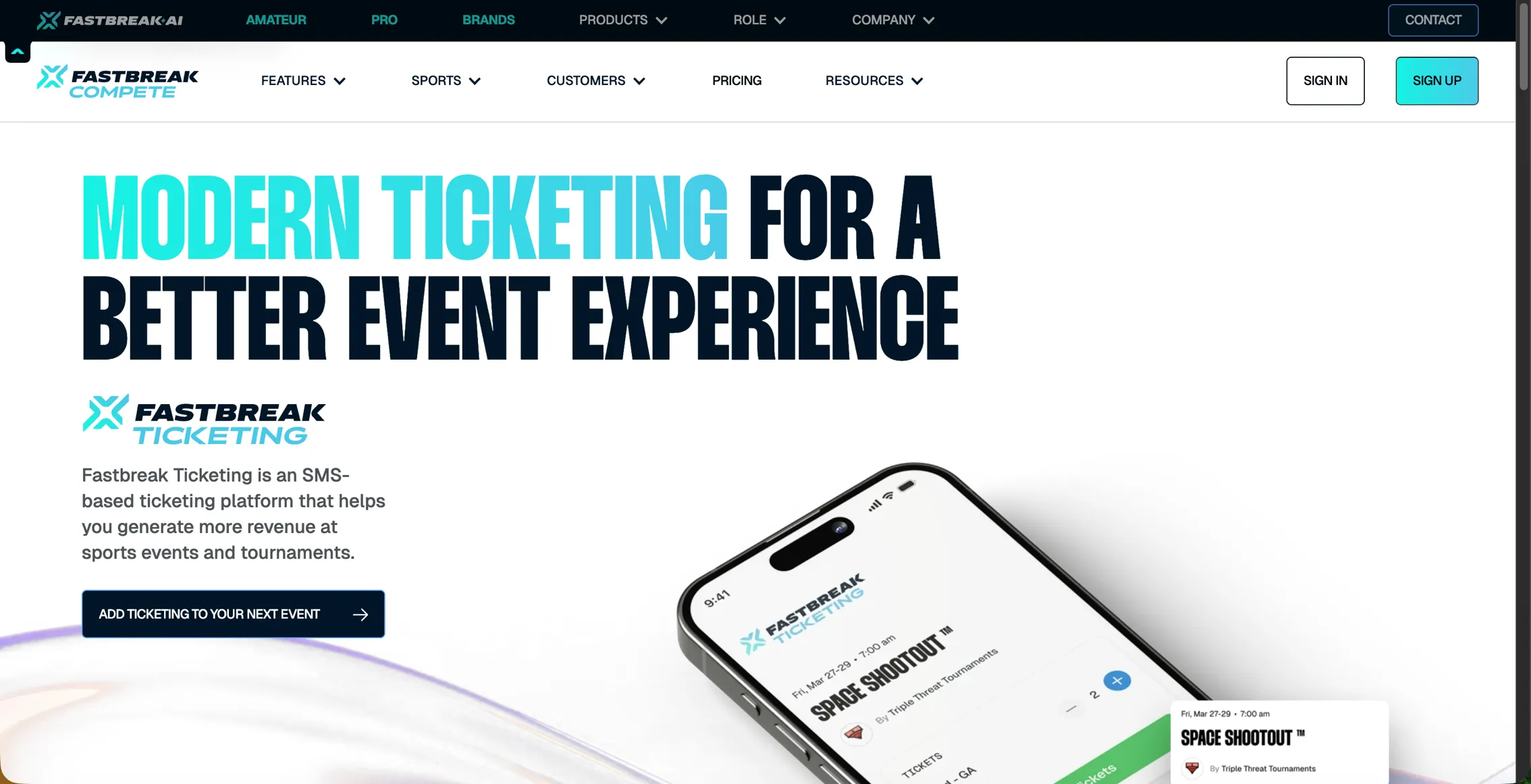
Fastbreak AI is a sports technology platform that covers the full range of sports operations, from scheduling and registration to travel, ticketing, and brand activations. Fastbreak Ticketing gives tournament directors two deployment paths depending on their setup. The platform manages operations for 10M+ athletes annually across thousands of youth events.
Key Features
- SMS-based ticket delivery straight to Apple Wallet or Google Pay requires no app download for fans
- Offline scanning is built for remote field complexes where Wi-Fi is unreliable
- Sponsor injection places branded coupons directly on digital wallet passes to generate activation revenue
- Native integration with Fastbreak Compete means schedule changes update the gate automatically
Limitations
- Maximum value requires running integrated revenue streams including housing, ticketing, and sponsors together
- Advanced optimization features may have a learning curve for first-time tournament directors
- Best suited for multi-venue events instead of single-facility recreational leagues
- Requires upfront time investment to input venue data and define scheduling constraints properly
- Pricing structure differs from simple monthly subscription models used by basic bracket tools
Bottom Line
Fastbreak AI is best suited for tournament directors running multi-day, multi-venue events where offline reliability, sponsor monetization, and scheduling integration all need to work together. Organizations managing large youth tournaments with housing blocks, shifting brackets, and sponsor activations will get the most out of what the platform offers. Smaller single-venue operators or recreational leagues with basic scheduling needs may find the platform's depth exceeds their current requirements.
Vivenu

Vivenu is an API-first ticketing infrastructure designed for large venues with permanent hardware installations. It targets stadium operators and enterprise clients who need deep technical customization and long-term contract flexibility. The architecture focuses on developer control over turnkey deployment, making it a heavy lift for operators without dedicated IT staff.
Key Features
- API-first architecture gives enterprise clients deep customization control over their ticketing setup
- Turnstile and stadium access control hardware integration supports permanent venue installations
- White-label branding options let large venue operators present ticketing under their own identity
- Multi-venue coordination handles the scale demands of stadium-class events
- Custom enterprise pricing accommodates the contract structures that large venue operators require
Limitations
- No SMS-based ticket delivery to digital wallets, so fans face more friction at entry
- No offline scanning capability, which creates risk at venues where connectivity is unreliable
- API-first setup requires developer resources before the system is usable for any event
- No sponsor injection features, so organizers cannot place branded content directly on digital passes
- No integration with tournament scheduling systems, meaning schedule changes require manual gate updates
Bottom Line
Vivenu is best suited for permanent stadium operators with dedicated IT staff and long-term infrastructure contracts. Bundesliga-scale venues, arena operators, and organizations running events at fixed facilities with installed turnstiles get the most out of what Vivenu offers. For tournament directors managing temporary multi-venue setups, the setup complexity and missing mobile features make it a poor fit compared to solutions built for that environment.
TicketSpice

TicketSpice is a flat-fee ticketing tool built primarily for small community events where keeping transaction costs low is the main priority. At 99 cents per transaction, it appeals to organizers running straightforward, low-volume events at single venues. The feature set reflects that narrow focus, with limited capability beyond basic ticket sales and entry validation.
Key Features
- Flat 99-cent-per-transaction pricing keeps costs predictable for small, low-volume events
- A DIY page builder lets organizers create basic event pages without developer help
- Entry validation supports simple gate operations at single-venue events
- Third-party scanning app compatibility provides a basic check-in option at the door
- Offline scanning is available in limited form for venues without reliable connectivity
Limitations
- No SMS-based ticket delivery to digital wallets, adding friction for attendees at the gate
- No sponsor injection features, so organizers have no way to place branded content on digital passes
- No integration with tournament scheduling systems, requiring manual updates when schedules change
- Page builder is disconnected from any live event data, so schedule changes do not propagate automatically
- Best suited for events under 500 attendees, with limitations that compound quickly at higher volumes
Bottom Line
TicketSpice works well for small, single-venue community events where low transaction fees are the primary concern and no sponsor monetization or scheduling integration is needed. Organizers running one-day festivals, local fundraisers, or small gatherings with straightforward gate operations will find it adequate for their needs. Tournament directors managing multi-venue events with shifting schedules, sponsor activations, and high attendance volumes will find the platform's limitations outweigh the savings on per-ticket fees.
TicketLeap

TicketLeap is a self-service ticketing tool built for general events like local theater and community gatherings. At $1 plus 2% per ticket, fees scale with volume in ways that quietly reduce organizer margins at larger events. The platform offers basic event page creation and entry validation with no sports-specific capabilities.
Key Features
- Self-service event page creation lets organizers publish basic event listings without technical help
- Percentage-based fee structure keeps upfront costs low for very small, low-attendance events
- Generic event templates cover a wide range of non-sports use cases
- Basic entry validation supports simple gate operations at single-venue events
- Mobile ticket display allows attendees to present tickets from their phone at the door
Limitations
- No SMS-based ticket delivery to digital wallets, creating friction at the gate for attendees
- No documented offline scanning capability, leaving gate operations vulnerable when connectivity drops
- No sponsor injection features, so organizers cannot place branded content on digital passes
- No integration with tournament scheduling systems, requiring manual updates whenever schedules change
- Percentage-based fees compound quickly at higher volumes, making it increasingly costly for large events
Bottom Line
TicketLeap works adequately for small, single-day events at permanent venues with stable connectivity where basic ticket sales and entry validation are the only requirements. Organizers running local theater productions, community fundraisers, or one-day gatherings will find it covers their needs without much setup friction. Tournament directors managing multi-venue sports events with shifting brackets, sponsor activations, and high attendance will find that the fee structure and missing features create more problems than the platform solves.
Eventbrite
Eventbrite is the largest general-purpose ticketing platform available, covering everything from yoga classes to stadium concerts. Entertainment and sporting events together accounted for more than 1.3 billion digital ticket transactions in 2023, and Eventbrite captures a wide slice of that volume. The platform's broad scope means it serves many use cases adequately but few with the depth that specialized operators require.
Key Features
- A large existing audience marketplace gives organizers some built-in event discovery exposure
- Generic event templates cover a wide range of event types without requiring technical setup
- Basic mobile ticket display allows attendees to present tickets from their phone at the door
- Self-service event page creation lets organizers publish listings without developer help
- Payment processing is handled natively, removing the need for a separate merchant account
Limitations
- Fees at 3.7% plus $1.79 per sold ticket compound quickly at high attendance volumes
- Attendee data ownership is retained by Eventbrite, so organizers cannot build their own returning fan database
- No offline scanning capability, leaving gate operations vulnerable when connectivity drops
- No sponsor injection features, so organizers cannot place branded content on digital passes
- No integration with tournament scheduling systems, requiring manual updates whenever schedules change
Bottom Line
Eventbrite works well for general one-day events at permanent venues with stable connectivity where broad audience discovery and simple ticketing are the primary needs. Organizers running concerts, fitness classes, or single-venue community events will find the platform covers the basics without much friction. Tournament directors managing multi-venue sports events with shifting schedules, sponsor activations, and high attendance volumes will find the fee structure and missing features create real costs that outweigh the convenience of the platform's name recognition.
Playpass

Playpass is a scheduling tool built for recreational leagues that generates optimized brackets and exports data via CSV. It has no native connection to ticketing, housing, or sponsor systems, making it a narrow solution for operators who need more than schedule creation. For directors managing complex multi-venue events, Playpass solves one piece of the puzzle and leaves the rest to manual processes.
Key Features
- Automated bracket generation handles scheduling for recreational leagues
- Constraint-based scheduling supports simple single-facility event planning
- CSV export allows manual data transfer to outside systems
- Lightweight setup makes it accessible for small rec leagues with basic needs
- No technical integration requirements keep the onboarding process straightforward
Limitations
- No ticketing functionality, so organizers must manage gate operations through a separate system
- No housing or travel integration, leaving teams to book accommodations without any compliance tracking
- No sponsor injection or monetization features of any kind
- CSV-based data transfer creates manual steps every time information needs to move between systems
- No real-time schedule update capability, meaning gate and app data fall out of sync when changes occur
Bottom Line
Playpass is best suited for small recreational leagues where schedule creation is the only requirement and operators have no need for ticketing, housing, or sponsor revenue tools. League coordinators running low-volume, single-facility events with stable rosters and predictable formats will find it covers that narrow use case adequately. Tournament directors running multi-day, multi-venue events who need ticketing, housing compliance, and sponsor activation working together will find that Playpass solves the scheduling math and little else.
Feature Comparison Table of Free Mobile Ticketing Services
Here's how the six services stack up across the features that matter most for live event operations:
Each service covers at least one use case adequately. Only Fastbreak AI covers the full range of features listed above.
Why Fastbreak AI Is the Best Free Mobile Ticketing Service
Every other service reviewed here treats the ticket as a transaction endpoint. Fastbreak AI treats it as a starting point for revenue, operations, and fan experience running in parallel. That architecture is what sets it apart. Schedule changes push to the gate automatically. Sponsor coupons ride along on every wallet pass. Housing compliance tracks inside the same dashboard. No CSV exports, no manual updates, no disconnected systems to babysit across six fields on a Saturday. For tournament directors running multi-day, multi-venue events, that integration is not a bonus feature. It is the difference between a smooth event and a logistical fire drill. No other free mobile ticketing service on this list comes close to matching that combination.
Final Thoughts on Selecting Mobile Ticketing Software
You can find a free mobile ticketing service that scans tickets at the gate without much trouble. Finding one that connects to your schedule, monetizes sponsors on every wallet pass, and keeps scanning live when the Wi-Fi drops is a different story. Fastbreak AI was built for tournament directors who need all three working at once. If that describes your operation, contact us and we'll show you exactly how the integration works across scheduling, ticketing, and sponsor activation in real tournament conditions.
FAQ
Which free mobile ticketing service works best for multi-venue tournaments?
Fastbreak AI is built for multi-venue tournaments where schedules shift, Wi-Fi is unreliable, and sponsor revenue matters. It offers offline scanning, SMS delivery, and sponsor injection features that single-venue services skip entirely.
How do I choose between low-fee ticketing services and integrated platforms?
If you're running a small, single-day event at one venue with stable Wi-Fi, low-fee services like TicketSpice work fine. For multi-day tournaments with housing blocks, schedule changes, and sponsor activations, an integrated platform that connects ticketing to your entire operation saves far more than the fee difference.
Can I use a free mobile ticketing service without requiring fans to download an app?
Yes. SMS-based ticketing delivers tickets straight to Apple Wallet or Google Pay, so fans show their phone at the gate without downloading anything. Most general-purpose ticketing services still require app downloads, which creates friction at youth sports events where parents manage multiple children across different age groups.
What does offline scanning actually mean for remote field complexes?
Offline scanning lets gate staff validate tickets when Wi-Fi drops or doesn't exist at all. The scanner stores ticket data locally and syncs later. For remote field complexes, this prevents gate delays when connectivity fails, a common reality at outdoor sports venues.
How do sponsor monetization features work within ticketing systems?
Sponsor injection places branded coupons directly on digital wallet passes, so every ticket doubles as a sponsor touchpoint. Brands pay activation fees for that exposure, turning your gate into a revenue channel beyond just ticket sales. Most free mobile ticketing services treat tickets as transactions and skip this monetization layer entirely.


