






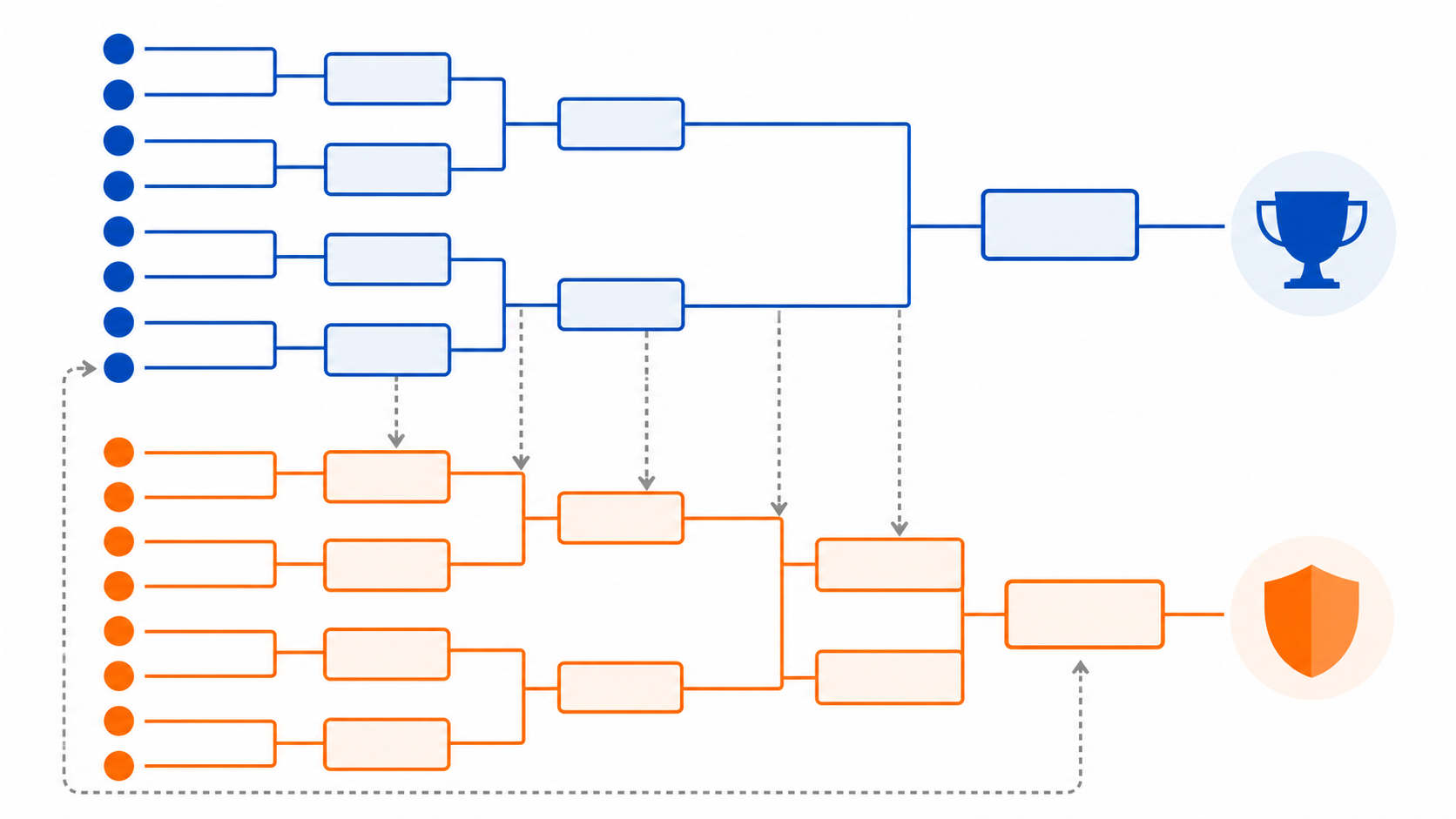
A double elimination bracket gives every team a second shot, but it also comes with a real cost: roughly twice the games, twice the field time and a grand final that might reset and go one more round. Whether that tradeoff works for your event depends on your team count, your venue window and what you owe the families who showed up. Here's what you need to know before you commit to the format.
Executive Summary:
- A double elimination bracket requires 2 losses to eliminate a team, with the formula 2(N-1) to 2(N-1)+1 total games. Plan your venue window around the maximum.
- An 8-team bracket runs 14-15 games, roughly double single elimination's 7, so plan your venue window around the maximum.
- Use double elimination when teams have traveled and your field is 16 teams or fewer in a single bracket.
- The bracket reset in the grand final only triggers if the losers bracket champion wins, adding one possible extra game.
- Fastbreak AI for Tournaments builds your schedule in minutes from the rules you set, flags conflicts and lets you adjust games with drag-and-swap editing.
What Is a Double Elimination Tournament?
In single elimination, one bad game and you're done. Double elimination gives every team a second life.
The rule is simple: you have to lose twice to be out. A first loss drops you from the winners bracket into the losers bracket, where you keep playing. Lose again there, and your tournament is over. Win enough in the losers bracket, and you can fight your way back to a championship.
That one rule changes how a tournament feels. Teams stay invested longer, upsets get corrected more often, and the strongest teams often reach the final. The Little League World Series uses this format for exactly that reason: a team can drop a game early and still win the championship.
How the Double Elimination Bracket Works
A double elimination tournament splits into two brackets: the winners bracket and the losers bracket. Every team starts in the winners bracket. Lose once, you drop to the losers bracket. Win every game in the winners bracket and you reach the grand final undefeated.
Teams in the losers bracket must win every subsequent game. One more loss and they're out. The losers bracket champion earns a spot in the grand final against the winners bracket champion.
That's where the bracket reset comes in. If the losers bracket champion beats the undefeated winners bracket champion, the score resets and they play one deciding game. A second loss ends it for the winners bracket champion.
The Double Elimination Formula: Calculating Games
For N teams, the formula is: guaranteed games = 2(N-1), maximum = 2(N-1)+1. The extra possible game is the bracket reset in the grand final.
Here's what that looks like across common field sizes, per match count breakdowns for every major format:
The reset only occurs if the losers bracket champion beats the winners bracket champion in the grand final. Plan your schedule around the maximum so you're not scrambling for field time if it happens.
Bracket Sizes: 4, 5, 6, 7, 8, and 11 Teams Explained
Each bracket size behaves a little differently, mostly because powers of two (4, 8, 16) fit neatly while odd numbers require byes, something any good sports schedule maker needs to account for to keep the bracket balanced.
- 4 teams: The cleanest bracket. Two first-round games, losers drop immediately. Expect 6-7 total games, no byes needed.
- 5 teams: One bye in round one. One team skips directly to round two in the winners bracket. Plan for 8-9 games total.
- 6 teams: Two byes required. The bracket fills out over more rounds than you'd expect for a six-team field. Budget 10-11 games.
- 7 teams: One bye, with slightly more rounds on the losers side. Total games land around 12-13.
- 8 teams: Another clean power-of-two bracket. Three winners bracket rounds, a deep losers bracket and a grand final. Expect 14-15 games, as confirmed by match count data for double elimination.
- 11 teams: Five byes spread across the bracket. The losers side gets long, so schedule extra time. Total games run 20-21.
When your team count falls between powers of two, byes go to the highest seeds in round one, keeping the early losers bracket from getting lopsided.
Double Elimination vs. Single Elimination vs. Round Robin
Choosing a format comes down to four things: how many games you can fit, how fair you want the outcome to be, how much time you have and how clear you need the result to be.
Single elimination is the fastest option. Every round cuts the field in half, and the whole thing wraps up in N-1 games. For 8 teams, that's 7 games. The downside is obvious: one off day and a strong team goes home early with nothing to show for it.
Double elimination fixes that at a cost. For those same 8 teams, you're looking at 14-15 games instead of 7. You get a legitimate second chance and a more defensible champion, but you need roughly twice the field time.
Round robin takes it further. Every team plays every other team, which produces the fullest picture of standings but balloons the game count fast. Eight teams require 28 games, roughly double what double elimination needs. It works well for league play or small groups where full rankings matter, but the game count can make it a tough fit for a single-day event with a hard stop time.
Seeding and Byes in Double Elimination Brackets
Seeding determines who plays whom and when. In a seeded draw, the top seed faces the lowest seed in round one, the second seed faces the second-lowest, and so on. This keeps the strongest teams from colliding until later rounds, rewarding regular-season performance and producing more competitive late-round matchups.
Byes come into play when your field size isn't a power of two. With 5 or 6 teams, the bracket needs placeholder slots to stay structurally sound. Higher seeds earn those byes, skipping round one and entering in round two. Byes can also appear on the losers bracket side: when an odd number of teams drop from the winners bracket in the same round, one losers bracket team may advance without playing, keeping the bracket from becoming lopsided.
The Grand Final and Bracket Reset
The grand final pairs two survivors who got there by very different roads. The winners bracket champion arrives undefeated. The losers bracket champion has already absorbed one loss and won every game since.
If the winners bracket champion wins the grand final, the tournament ends with them going undefeated start to finish. If the losers bracket champion wins, the bracket resets. Both teams now have exactly one loss, and a true final decides the champion. That reset is why the maximum game count is 2(N-1)+1 and not simply 2(N-1).
Some organizers skip the reset, declaring the winners bracket champion the winner regardless of the grand final result. It saves time when you're running a tight Saturday schedule with a venue hard out. The tradeoff is fairness: removing the reset means the winners bracket champion can lose the grand final and still win the tournament. Most serious competitions keep the reset. Recreational one-day events sometimes drop it.
Which Sports Use Double Elimination
Double elimination shows up across more sports than most people realize. Baseball leans on it heavily at the highest levels: the NCAA Division I regionals and the College World Series both run double elimination in bracket play, and Little League Baseball uses it for World Series competition as well. The format suits baseball well because a single bad pitching performance or an error-filled inning can sink an otherwise strong team.
Wrestling has used it for decades, particularly at regional and state qualifiers. Pool and billiards tournaments almost universally default to double elimination since match outcomes can hinge on a single unlucky roll. esports LAN tournaments have adopted it widely too, especially in titles like StarCraft, Street Fighter and Rocket League, where losers bracket runs are part of the competitive culture.
Football and basketball tend not to use it at the postseason level due to broadcast scheduling, though a basketball schedule maker can still apply the same bracket logic for amateur events. Softball mirrors baseball's adoption closely, with double elimination appearing at travel ball tournaments across all age groups, much like when clubs build a basketball club tournament schedule.
Pros and Cons of Double Elimination
The double elimination format rewards consistency, but it asks more of your schedule and venue. Here's a clear look at both sides.
Pros
- Every team plays at least two games, so no one drives four hours to get knocked out in a single match and sent home.
- A bad first game doesn't end anyone's tournament. Strong teams that stumble early still have a path back.
- The champion earns the title across a longer, harder road, which makes the result harder to dispute.
Cons
- Game count roughly doubles compared to single elimination. For 8 teams, you're scheduling 14-15 games instead of 7.
- Venue time and field availability become real constraints fast, especially on a one-day event.
- The losers bracket can stack games late in the day as rounds collapse toward the grand final, creating tight turnarounds for teams and referees, a challenge familiar to anyone who has had to build a soccer tournament schedule.
- Bracket logic gets complicated for non-standard field counts, and a grand final reset can push your end time past what you planned.
When to Use Double Elimination (and When Not To)
Double elimination fits best when travel is involved. If families drove six hours to get there, a single-game exit feels like a letdown. Guaranteed second games make the trip worthwhile and keep attendance from cratering after round one, which is part of a good youth sports tournament schedule.
Field size matters too, whether you build an ice hockey tournament schedule or another sport. Brackets up to 16 teams stay manageable over a weekend, assuming you have enough fields or courts. Once you push past 16 in a single bracket, the losers side gets long and late rounds stack up fast. At that point, pool play into a single elimination playoff often makes more logistical sense.
Use double elimination when:
- Teams have traveled and need at least two guaranteed games
- Your field is 16 teams or fewer in a single bracket
- Competitive credibility matters and you want a defensible champion
- You have enough venue time to absorb the maximum game count
Skip it when:
- You're running a one-day event with a hard venue cutoff and a large field
- A league-style format with full standings would serve the group better
- Your team count is high enough that pool play would cut games without sacrificing fairness
How to Run a Double Elimination Tournament Step by Step
Running a double elimination tournament takes more upfront planning than single elimination, but the steps are straightforward once you know the sequence.
Start by counting your teams and assigning seeds based on record, rating or prior results. Seeds set your first-round matchups and determine who gets byes if your field isn't a power of two.
Next, draw your bracket. Top seed plays the lowest, second plays second-lowest. Map out both the winners bracket and losers bracket before anyone plays, so you avoid double-booked tournament fields once games start stacking up.
Then set game slots against your venue availability. Count your maximum possible games (2N-1) and block time working backward from your hard end time, leaving buffer for a potential bracket reset.
Before play starts, communicate the rules to every team: how the losers bracket works, what triggers elimination and whether you're running a bracket reset in the grand final.
Finally, track results in real time and update the bracket immediately after each game. Losers bracket pairings depend on which teams drop and when, so delays can send the wrong teams to the wrong games.
How Fastbreak AI Handles Double Elimination Scheduling
Fastbreak AI for Tournaments runs the same AI scheduling engine that builds season schedules for the NBA and NHL, applied to your amateur tournament. Set your rules, including divisions, guaranteed games and venue hours, and get a full schedule in minutes.
If your rules can't all be met, the platform flags the conflict and lets you generate anyway or adjust. From there, drag-and-swap editing lets you move any individual game and the schedule adjusts automatically. See how sports schedule optimization works in practice.
Use the 2(N-1) to 2(N-1)+1 game count math from this guide to size your venue window, then enter your rules and let the platform build the schedule. Schedules, scores and updates made in the platform flow to the Fastbreak mobile app automatically, so teams and families see changes as they happen.
Final Thoughts on Choosing and Running a Double Elimination Tournament
Double elimination asks more of your schedule but gives your teams a better experience in return. Get your game count right, seed your bracket cleanly and leave room for a bracket reset, and the day tends to take care of itself. Drop the Fastbreak AI team a note if you want a bracket that builds itself around your constraints.
FAQ
What is double elimination meaning in tournament formats, and how does it differ from single elimination?
Double elimination means a team must lose twice to be eliminated. A first loss drops you to a losers bracket where you keep competing, while a second loss ends your tournament. Single elimination removes a team after one loss, which cuts game counts nearly in half but gives strong teams no recovery path after a bad game.
What is the double elimination tournament formula for calculating total games?
The formula is: guaranteed games = 2(N-1), maximum games = 2(N-1)+1, where N is your team count. The extra game is the bracket reset in the grand final. For a double elimination bracket with 8 teams, that means 14-15 games; plan your venue window around the maximum so a reset doesn't catch you short on field time.
Double elimination bracket 4 teams vs 8 teams: which should I run for a one-day event?
A 4 team double elimination bracket runs 6-7 total games and fits comfortably in a single day with minimal field pressure. An 8 team double elimination bracket needs 14-15 games, which works on a full weekend but gets tight on a single day with a hard venue cutoff. If you're running one day with 8 teams, confirm your maximum game count against available hours before committing to the format.
How do I set up a seeded double elimination bracket for 5 or 6 teams?
Start by ranking teams by record, rating or prior results, then match the top seed against the lowest in round one. For a 5 team double elimination bracket or a 6 team double elimination bracket, assign byes to the highest seeds since those field sizes fall between powers of two. Higher seeds skip round one and enter in round two, keeping the early losers bracket from becoming lopsided before meaningful games are played.
What is the fastest way to generate a free double elimination bracket for a tournament?
Fastbreak AI for Tournaments builds your tournament schedule in minutes once you set your rules, including guaranteed games, divisions and venue hours. The platform flags rule conflicts so you can generate anyway or adjust, and drag-and-swap editing lets you change individual games without rebuilding the schedule.


