






Most tournament schedules fail the same way: the rules live in someone's head instead of in the system. A facility that's unavailable after 8 PM and a promise of three pool games per team are both rules, and a spreadsheet can't check either one for you. Automated tournament scheduling turns each rule into a constraint and checks each one against every game at once. When you patch conflicts one at a time, you're just moving problems around. When the system checks every rule together, it either builds a schedule that meets all of them or shows you which ones can't be met and why.
Executive Summary:
- A constraint is a rule the schedule has to follow, like venue hours, guaranteed games or divisions. In Fastbreak AI, every rule you set is treated as required.
- The scheduler checks every constraint against every game at once, which avoids the cascade of new conflicts that one-at-a-time manual fixes create.
- When two constraints can't both be met, the scheduler flags the conflict and shows which ones can't be met, so you decide whether to generate anyway or adjust your rules.
- Fastbreak AI for Tournaments is built on the same scheduling technology Fastbreak uses for professional leagues like the NBA, NHL, MLB and MLS, and builds a full schedule in minutes for tens, hundreds, or thousands of teams.
Understanding Constraints in Tournament Scheduling
Every tournament schedule starts with rules. A venue is only available until 6 PM. A team can't play two games at once. Every team in a division gets at least three pool games. Each of these is a constraint: a condition the finished schedule has to satisfy.
In automated scheduling, most constraints fall into two familiar types:
- Structural constraints describe the shape of the event, like divisions, pool sizes, bracket formats and guaranteed games.
- Resource constraints describe what you have to work with, like venues, courts and the hours each one is open.
Each rule sounds simple on its own. The hard part is checking all of them against each other across hundreds of games.
Manual scheduling collapses under the weight of competing constraints because human schedulers can only hold so many variables in mind at once. They patch conflicts one at a time, often creating new ones in the process. AI-powered scheduling checks every constraint at the same time across the full schedule. That's why it pays to enter every rule you care about. The scheduler can only respect the rules it knows about.
Common Constraints: The Rules That Define Tournament Structure
Constraints are the boundaries the scheduler works inside. Every rule you set is treated as required. The most common constraints in tournament scheduling include:
- Venue availability windows (a facility closes at 8 PM regardless of what's left to schedule)
- Team conflict prevention (no team plays two games at the same time)
- Guaranteed games (every team in a division gets the same minimum number of games)
- Coach requests (a coach with several teams asks not to be double-booked), added as a rule
- Minimum rest periods between games
- Division integrity (teams only play within their registered division)
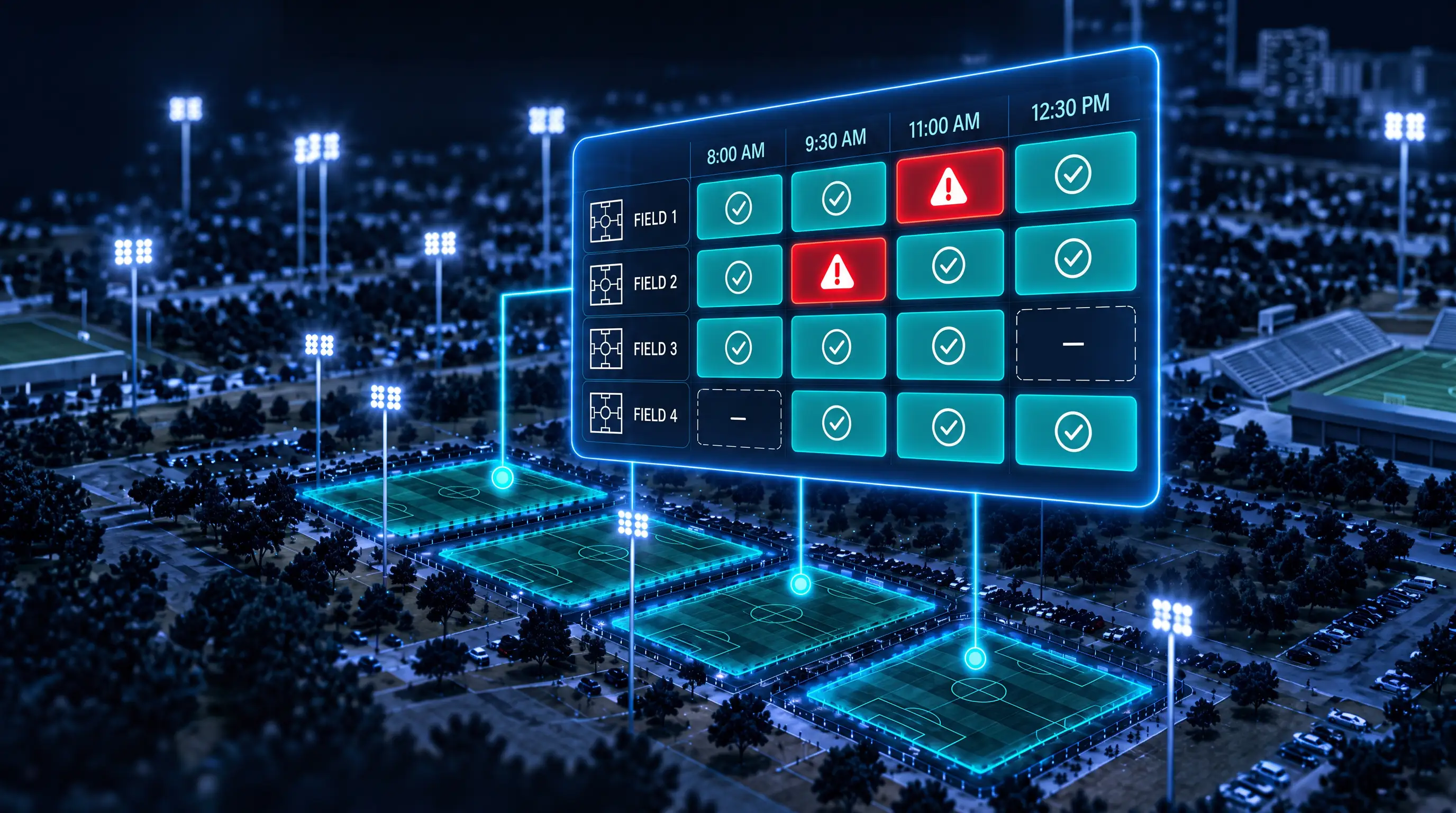
Because every rule is required, conflicts come to you instead of getting buried in the schedule. If two rules can't both be met, the scheduler flags the conflict and shows which ones can't be met. You can generate the schedule anyway or adjust your rules and run it again. That matters more than it sounds. A schedule that looks clean on paper but quietly misses a rule falls apart at the venue.
Human schedulers typically check constraints manually, one conflict at a time. At scale, that process breaks down fast.
Requests and Preferences: Turning Them Into Rules
Some of what makes a tournament feel well run starts as a request: a coach who wants later games, a team driving in from out of state, a director who wants courts filled evenly. In Fastbreak AI, requests work the same way as every other rule. If something matters to your event, you add it as a rule. Common requests directors turn into rules include:
- Team time preferences, like a team that can't arrive before 10 AM
- Coach requests for teams that share a coach, so one coach isn't scheduled on two courts at once
- How full you want courts at each venue
- A fair spread of early and late time slots across divisions
- Seeding that keeps top teams apart in early bracket rounds
Every request you add carries the same weight as your other rules, so be deliberate about which ones you include. A request becomes part of the schedule only if it fits with everything else you've set. When one clashes, the scheduler flags which rules can't be met so you can decide what to change.
What separates good scheduling software from great scheduling software is how clearly it tells you when your rules don't fit together.
Common Tournament Formats and Their Scheduling Requirements
Format choice carries real consequences that ripple through every scheduling decision that follows. Each format changes which constraints matter most. Knowing that upfront helps you set the right rules before the scheduler generates a single slot.
Single Elimination
Every loss ends a team's tournament. That creates a clean bracket structure, but scheduling pressure is high since every game matters. Rest minimums and venue transitions matter most here, because one poorly assigned slot can ruin a team's experience.
Double Elimination
Teams get a second chance, which means more games across more rounds. Venue hours and coach requests get tighter, and the schedule has to fit a longer event into the same facilities without overbooking them.
Round Robin and Pool Play
Every team plays every other team in their pool before advancing. Rest spacing, venue assignments and time slot rotation all need to be set as rules the scheduler checks together. Teams playing three pool games in a day need reasonable spacing. So does the facility.
Pool Play to Brackets
The most common format in large youth events, this hybrid creates two scheduling phases with different constraints. Pool play leans on guaranteed games and an even spread of time slots. Brackets lean on seeding and division rules.
Tournament Format Side-by-Side
The table below shows the key constraint for each format and a common request directors add as a rule.
The Mathematics Behind Constraint-Based Scheduling
Scheduling software built on heuristics follows a simple chain: if condition A, then do B. That works for isolated conflicts, but at scale, fixes create new problems somewhere else. The cascade never ends.
Constraint-based scheduling frames the entire problem as a mathematical model. Each rule you set becomes a constraint, and together they define which schedules are valid. The solver searches for a schedule that meets all of them. When no schedule can, it reports which rules are in conflict.
Constraint Programming vs. Integer Programming
Two approaches do most of the work here:
- Constraint programming assigns variables (games, teams, time slots, venues) and propagates rules across the entire model at once, pruning impossible configurations before ever generating them.
- Integer programming treats scheduling as a system of equations, where each rule is a condition the solution has to satisfy.
Academic research on constraint logic programming for sports scheduling shows how these mathematical approaches handle round-robin tournaments and multi-venue competitions more efficiently than heuristic methods, particularly as the problem grows. Fastbreak's engine is built on the same core technology Fastbreak uses for professional league schedules, which is why it can build schedules for hundreds of teams in minutes.
Here are some of the areas where constraint-based scheduling produces results heuristic methods can't match at scale:
- Every rule checked against every game slot, venue and team at once, without iterative patching
- Conflicting rules flagged and explained before you publish
- Rules you can edit at any time, with the full schedule re-run in minutes
- After the schedule is built, drag and swap games and the scheduler adjusts automatically
Why Heuristics Fail at Scale
At 50 teams, a human scheduler patching conflicts manually is manageable. At 500, it breaks down entirely. Fix one coach overlap, and a venue window tightens. Fix that, and a rest period shrinks. Constraint-based scheduling checks every rule at once, so a fix in one place doesn't quietly break something somewhere else.
Venue and Time Slot Management Rules
Managing venues and time slots is where constraints collide most visibly. A court that's double-booked, a team that can't reach the next field in time, an equipment changeover that runs long: any of these turns a clean schedule into a chaotic one. The rules here are about keeping the event running smoothly on the ground. The right approach encodes these requirements as rules from the start, so the scheduler checks every game against the hours each venue is actually open.
Buffer Times and Transition Windows
Back-to-back game scheduling without buffer time is a common mistake in manual builds. Facilities need breathing room between matches: typically 15 to 30 minutes between games at the same venue, and 60 minutes or more when a team must travel between separate facilities. When a tournament spans multiple sites, build that transit time into your rules before any slot gets assigned.
Equipment and Surface Changeover
Field sports carry additional requirements. Nets need adjusting, lines get rechecked, and surface conditions shift across divisions with different age groups. A schedule that ignores changeover time produces slots that work on paper but fail in practice, so build it into your venue hours.
Fairness Considerations: Balancing Competitive Equity
Fairness in tournament scheduling comes down to the rules you set. Every team in a division playing the same number of pool games is a guaranteed-games rule. Keeping top seeds apart in round one comes from seeding and divisions. You decide what fair looks like for your event, and the scheduler shows what can and can't be met. Fairness gaps rarely announce themselves on paper. A schedule can look valid while quietly giving one pool a rest advantage before bracket play, and that gap shows up in results.
Rest equity is the most common fairness gap in youth tournament scheduling. Two teams entering the same bracket round with a 90-minute rest difference aren't on equal footing. If rest matters for your event, make it a rule so the scheduler checks it for every team.
Seeding adds another layer. Proper bracket design keeps top seeds separated until late rounds, protecting competitive integrity and keeping meaningful games alive deeper in the event. Set seeding up as a rule from the start so it's checked alongside venue hours and guaranteed games.
Real-Time Adaptability: When Rules Must Change Mid-Tournament
Mid-tournament disruptions are part of the job, and how a scheduling system responds determines whether a delay becomes a setback or a full collapse. When a venue closes early or a team drops, your other rules still apply. A team still can't play two games at once. In Fastbreak AI, you can edit your rules at any time. For a few games, drag and swap them and the scheduler adjusts automatically. For a bigger change, update the rules and re-run the full schedule in minutes. Once the schedule is published, scores update in real time.
The NRL's schedule across 17 clubs optimized by Fastbreak AI shows the same core technology at the professional level.
Human schedulers rebuilding mid-event under pressure tend to patch the most visible conflict first. That fix often creates three quieter ones downstream. A scheduler that checks every rule at once sees the full picture before anything changes.
Registration and Entry Process Rules That Impact Scheduling
Registration data collected before scheduling shapes what the scheduler can produce. Three registration inputs matter most:
- Team limits per division set bracket sizes, which determine the minimum number of time slots and courts the schedule needs before any other rules apply.
- Division and age group selections decide which division each team is scheduled in.
- Payment status shows which teams are fully enrolled, so you can decide who goes into the schedule build.
When registration data is incomplete or inconsistent, the schedule needs corrections once it's cleaned up. On Fastbreak AI for Tournaments, registration, payments, scheduling, scoring and event websites live in one place.
How Fastbreak AI Turns Your Rules Into Schedules
Fastbreak AI for Tournaments is built on the same scheduling technology Fastbreak uses for professional leagues like the NBA, NHL, MLB and MLS. That matters because constraints get messier at the youth level, with more venues and more divisions running at once across a single weekend. Directors set rules like guaranteed games, divisions and venue hours. Every rule is treated as required. If rules conflict, the scheduler flags it and shows which ones can't be met, and you choose whether to generate anyway or adjust and run it again.
Final Thoughts on Tournament Scheduling Constraints
Manual scheduling breaks down when you try to hold every rule in your head at once, which is exactly where automated tournament scheduling takes over. A constraint is simply a rule the schedule has to follow. The scheduler checks all of them together before assigning a single game slot, and when two can't both be met, it tells you which ones and lets you decide. When operations scale past what spreadsheets can handle, constraint-based scheduling is the practical way forward. If you want to see how Fastbreak AI builds tournament schedules for hundreds of teams in minutes, contact us to walk through your setup.
FAQ
What is a constraint in tournament scheduling?
A constraint is a rule the finished schedule has to follow, like venue hours, guaranteed games per team, divisions or keeping a team from playing two games at once. Automated scheduling software checks every constraint against every game at once instead of one conflict at a time.
Does Fastbreak AI treat some rules as more important than others?
No. In Fastbreak AI, every rule you set is treated as required. If two rules conflict, the scheduler flags it and shows which ones can't be met. You can generate the schedule anyway or adjust your rules and run it again.
How do you handle mid-tournament disruptions when a venue becomes unavailable?
Update the venue's hours and re-run the schedule in minutes, or drag and swap the affected games and the scheduler adjusts automatically. Your other rules still apply, and the scheduler flags any that can't be met.
Should rest periods be a constraint?
If rest matters for your event, yes. Set minimum rest between games as a rule so the scheduler checks it for every team. Every rule is required, so a tight rest rule combined with limited venue hours can conflict. When that happens, the scheduler flags it and you decide which rule to adjust.
What registration data impacts automated scheduling before the first game slot is assigned?
Team limits per division determine the minimum time slots and courts required, and division selections decide where each team plays. If payment status is important to whether a team plays or not, the status shows which teams are fully enrolled and rules can be created against that criteria.


