







When you're scheduling 200 teams across a dozen fields, your league management software shouldn't require manual workarounds for basic conflicts like coaches managing multiple teams. We compared solutions based on what tournament directors actually need: AI scheduling that solves constraint problems at scale, integrated revenue streams including hotel rebates and Fastbreak Ticketing, and unified data flow without third-party patches. We also assessed compliance management capabilities (background checks, waiver collection, and eligibility verification) because Utah youth baseball leagues face real liability exposure when these workflows are handled outside the platform.
Executive Summary:
- Baseball league software manages multi-venue tournaments and hundreds of teams at scale.
- AI scheduling solves complex constraints like coach conflicts and travel time automatically.
- Integrated hotel rebates and Fastbreak Ticketing generate revenue beyond registration fees.
- Compliance tools including background check integrations, digital waivers, and age verification protect leagues from liability and satisfy governing body requirements.
Who This Guide Is For
Recreational League Directors
Recreational league directors run single-venue seasonal programs with 10 to 30 teams playing in one location across a spring or fall schedule. Their administrative needs are straightforward: getting teams registered, putting games on the calendar, and keeping parents informed. AI scheduling built for multi-venue events is not something these leagues need, and neither are hotel rebates or gate ticketing. Platforms like TeamSnap and LeagueApps are built for this tier and handle the core workflows well.
Travel Ball and Club Directors
Travel ball and club directors oversee year-round multi-team organizations where rosters shift across age groups, coaches manage several squads, and players attend tournaments hosted by outside operators. Keeping compliance records current is a constant burden. Rostering across a full club compounds that work, and coordinating travel across a long season pulls directors in a third direction before they can focus on anything else. These directors need a platform that connects registration, compliance records, and club-wide scheduling without requiring multiple third-party subscriptions. Fastbreak AI for clubs is built for this tier.
Tournament Directors
Tournament directors run multi-venue events that regularly draw 64 or more teams across several fields and facilities over a weekend or extended bracket. At this scale, AI scheduling is a practical requirement rather than a luxury. It accounts for coaching conflicts, travel time between venues, and facility availability automatically so directors are not resolving those problems by hand. Ancillary revenue is what separates profitable events from break-even ones, and the platforms that generate it do so through housing rebates, gate ticketing, and sponsor activation in a single connected system. Fastbreak AI for tournaments is built for this tier and handles all of these needs.
What is Baseball League Software?
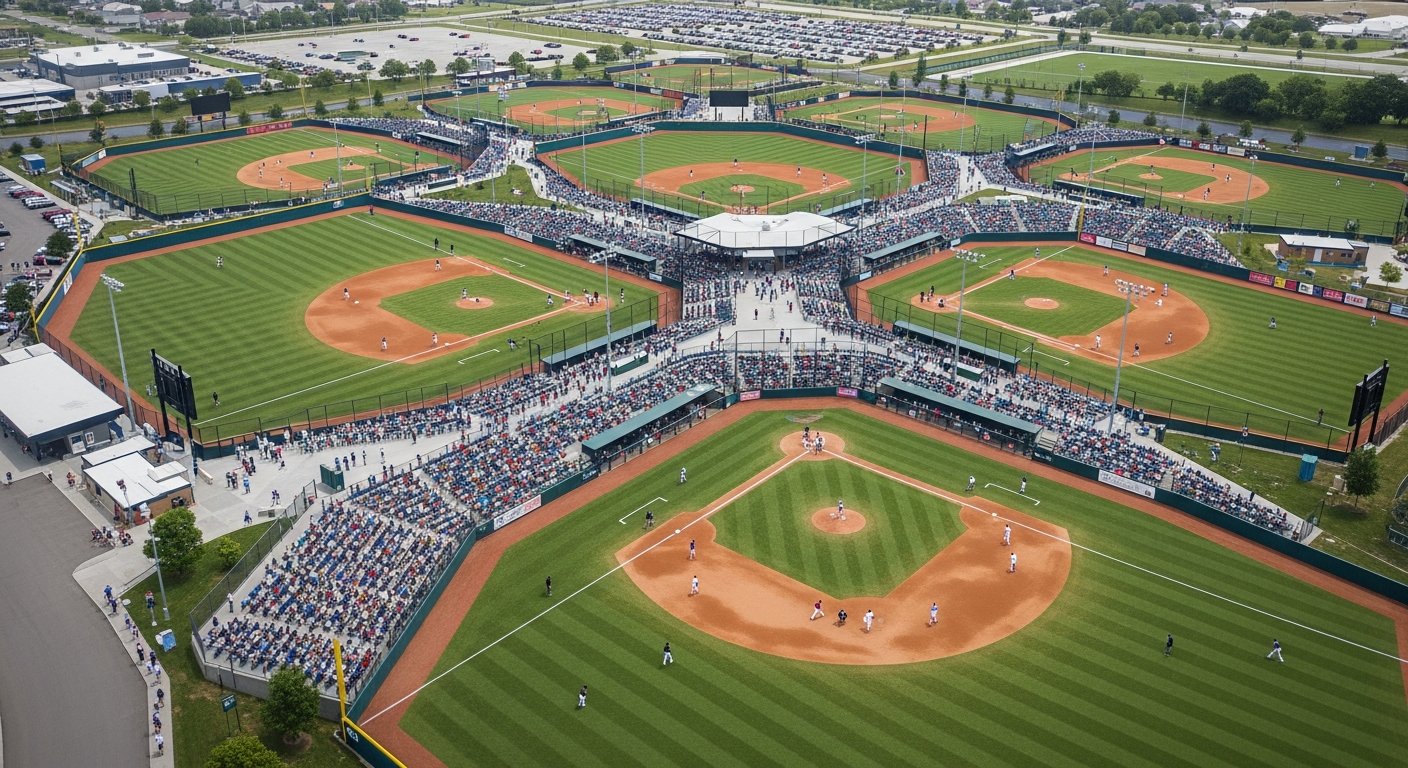
Baseball league software handles the day-to-day demands of running competitive baseball events across multiple fields and facilities. Unlike basic team apps for single rosters, league software manages hundreds of teams, coordinating schedules, tracking registrations, and running bracket competitions.
League software prevents double bookings across six fields, manages pool play rotations, tracks payments, and adjusts brackets in real time when weather forces rescheduling using sports scheduling software. Leagues across every competitive level rely on management software to handle these logistics at scale.
How We Ranked Baseball League Software
We ranked baseball league software based on what tournament directors need to run profitable multi-venue events. Here's what mattered in our ranking:
- Scheduling Power: Does the software use AI optimization to solve for travel, rest, and venue conflicts, or rely on manual drag-and-drop?
- Revenue Generation: Can you stack ancillary revenue streams (hotel rebates, ticketing, sponsorships) inside the same system, or are you limited to registration fees?
- Ecosystem Unity: Are scheduling, payments, housing, and communication natively built in, or do you need multiple third-party partners?
- Scalability: Can the system handle 1,000+ teams across a dozen facilities without manual workarounds?
- Compliance Management: Does the platform support background check integrations, SafeSport certification tracking, digital waiver collection, and age eligibility verification natively or through vetted integrations, or does it leave league administrators to manage compliance manually?
Best Overall Baseball League Software: Fastbreak AI

Fastbreak AI is the only platform that combines AI scheduling, housing management, Fastbreak Ticketing, and sponsor activation in one connected system for tournament directors who need to run profitable events at scale. The same AI scheduling engine that builds fixtures for the NBA and NHL now powers amateur tournaments, handling coaching conflicts, venue constraints, and travel time automatically. Fastbreak AI for tournaments provides tournament management combining registration, AI-powered scheduling, scoring, ticketing, travel, and sponsor activation in one system.
Key Features
- AI sports schedule maker builds complex brackets in minutes while automatically accounting for blackout dates, coach conflicts, rest requirements, travel time, and venue availability, cutting planning time that would otherwise require hours of manual work
- Integrated with Fastbreak AI for tournaments, Fastbreak Travel provides negotiated hotel rates, real-time compliance tracking, and rebates that return to the tournament operator
- Fastbreak Ticketing with offline scanning and sponsor coupon injection directly on digital wallet passes
- Unified data flow where registration automatically triggers hotel blocks and schedule changes update ticketing in real time
- Revenue share model that generates ancillary income through hotel rebates, gate tickets, and brand activations
Limitations
- Requires upfront time investment to input venue data and define scheduling constraints properly
- Advanced optimization features may have a learning curve for first-time tournament directors
- Pricing structure differs from simple monthly subscription models used by basic bracket tools
- Maximum value requires running integrated revenue streams together instead of standalone features
- Best suited for multi-venue events instead of single-facility recreational leagues
Bottom Line
Fastbreak AI is built for baseball tournament operators who control their venues and need to monetize events beyond registration fees. Organizations running 100+ team tournaments across multiple facilities who want to stack ancillary revenue through housing, ticketing, and sponsorships would benefit most from this platform. Utah-based tournament operators running events at complexes like Salado Sports Complex or Miller Park in the Salt Lake metro area can use Fastbreak AI to manage multi-field scheduling, capture hotel rebates from traveling teams, and maintain a compliance record of coach background checks and signed waivers in a single system.
TeamSnap
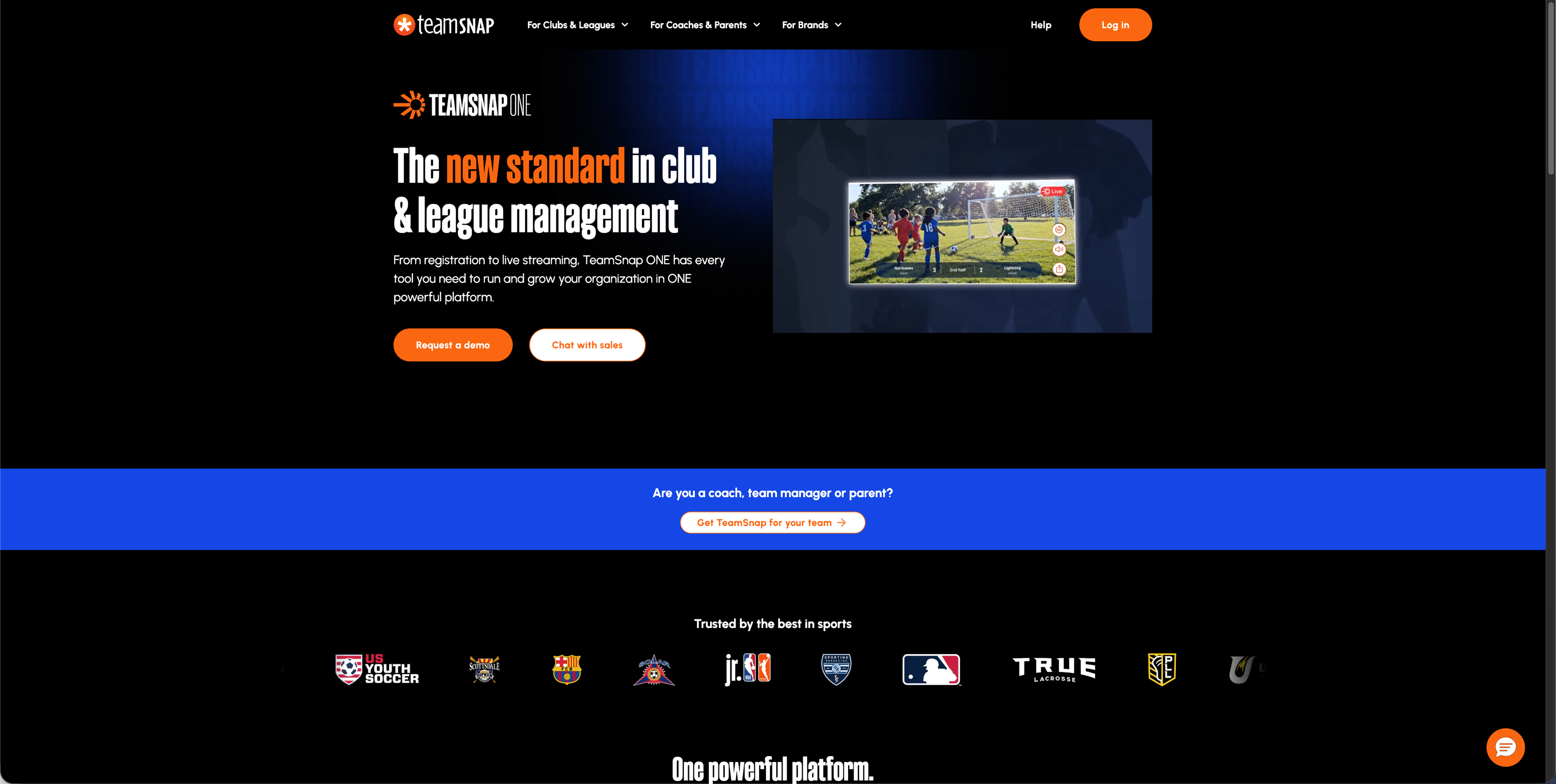
TeamSnap offers club and league management software under its TeamSnap ONE platform, serving recreational leagues and team coaches with org-level registration, live streaming, tournament brackets, and automated standings. Team coaches get messaging tools, volunteer coordination, practice calendars, and payment collection. The platform generates no ancillary revenue through hotel rebates, ticketing, or sponsor activation.
Key Features
- Online registration and payment collection for individual teams
- Team messaging and email communication tools
- Practice and game schedule management with automated reminders
- Volunteer coordination and carpool organization
- Mobile app access for coaches and parents
Limitations
- No AI scheduling optimization for multi-venue tournaments or coaching conflicts
- Lacks integrated hotel rebate programs and Fastbreak Ticketing capabilities
- No sponsor activation or ancillary revenue generation features
- Cannot generate revenue through gate ticketing or housing rebates
- Best suited for recreational leagues, not large-scale competitive tournament operations
Bottom Line
TeamSnap ONE covers the basics well: org-level registration, scheduling, and parent communication for single-venue seasonal leagues. Coaches coordinating rosters and carpools get what they need. Directors running multi-venue tournaments or trying to generate revenue beyond registration fees will hit the ceiling fast.
LeagueApps
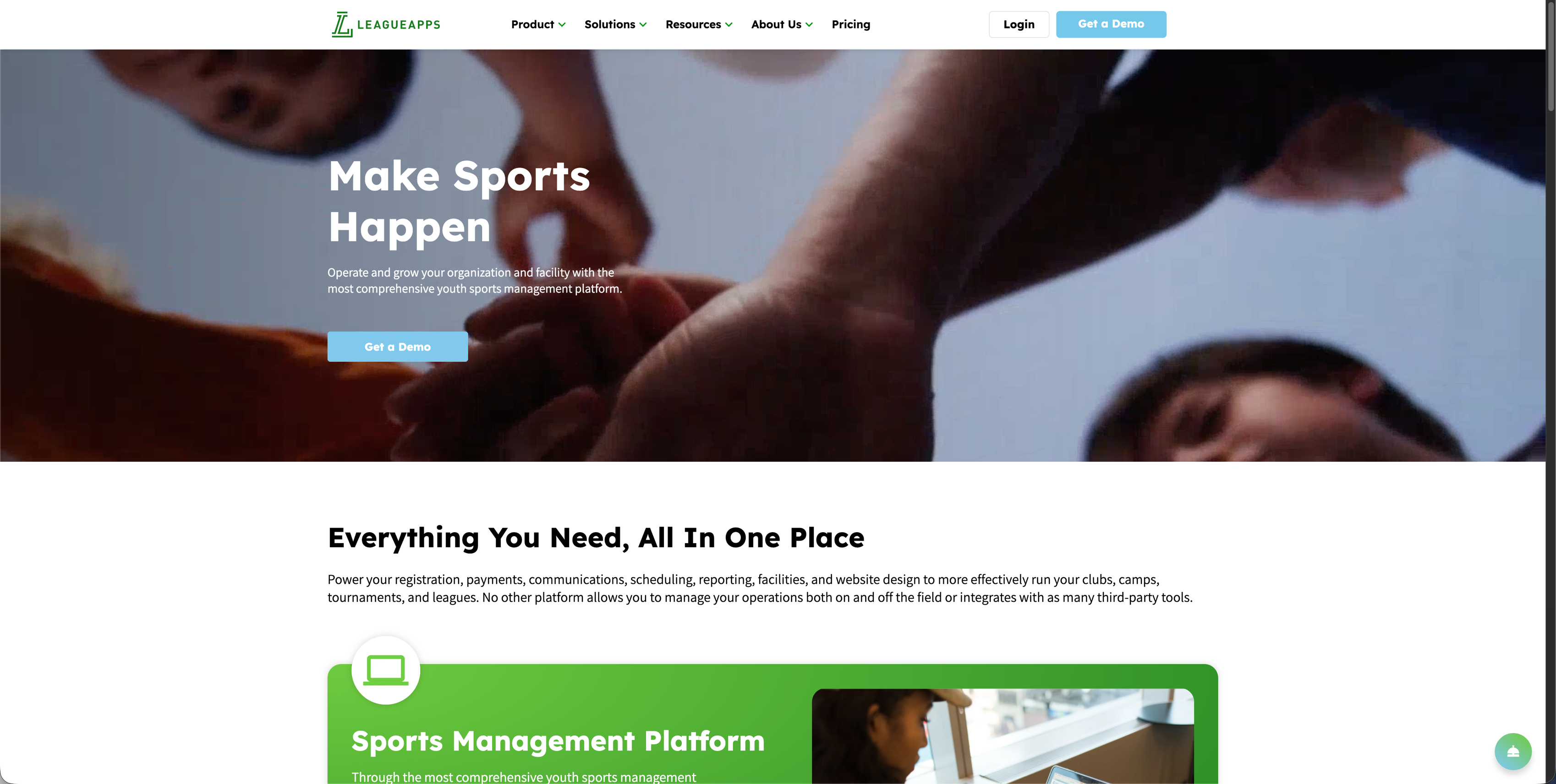
LeagueApps provides registration and basic scheduling for community leagues. The system relies on third-party partner integrations for critical functions like travel management and background checks. Setup fees have been reported around $495 (verify current pricing directly with LeagueApps).
Key Features
- Online registration with payment processing for league and tournament play
- Basic scheduling grid for local league games and practice times
- Customizable club websites with branded team pages
- Rostering tools for managing team assignments and divisions
- Email communication system for league announcements
Limitations
- Lacks native hotel rebate programs and integrated travel management
- No AI scheduling optimization for coaching conflicts or travel distance
- Mobile ticketing capabilities are not built into the platform
- Requires multiple third-party partner subscriptions for full functionality
- Cannot generate ancillary revenue streams beyond registration fees
Bottom Line
LeagueApps fits community leagues running single-venue seasonal programs where basic registration and scheduling cover the full scope of needs. Multi-venue tournament operators who need AI scheduling, hotel rebates, or gate ticketing will find the platform short on the revenue tools that make competitive events profitable.
GameChanger
GameChanger focuses on video streaming and scorekeeping for parents who want to watch games remotely. Consumer plans are available at varying price points, with entry-level options starting lower than previous tiers (as of mid-2026; verify current pricing at GameChanger's site). The software provides zero tournament control for directors as you can't build brackets, manage hotel blocks, or sell gate tickets.
Key Features
- Live game streaming for remote viewing by family members
- Scorekeeping with statistics tracking for individual players
- Score displays and game updates for fans following remotely
- Mobile app for parents and grandparents to watch games
- Team messaging and communication tools
Limitations
- No tournament bracket creation or management capabilities
- Lacks hotel coordination or travel management features
- Cannot handle gate ticketing or revenue generation
- No AI scheduling optimization for multi-venue events
- Designed for consumer viewing instead of tournament operations
Bottom Line
If your primary need is remote game viewing and player stat tracking, GameChanger covers that well. It is a consumer-facing product built for parents and grandparents in the stands, not directors managing brackets, housing, or gate revenue.
Stack Sports
Stack Sports manages acquired brands including PlayMetrics and Sports Connect, which have now merged under a unified platform. Sports Connect and PlayMetrics together cover registration and practice scheduling. Integration between remaining products varies, and operators moving between platforms may encounter data migration requirements.
Key Features
- Online registration and payment processing through the merged Sports Connect and PlayMetrics platform
- Practice and game scheduling via PlayMetrics
- Communication tools across product interfaces
- League and tournament management capabilities
Limitations
- Platform consolidation is ongoing and operators may face data migration requirements when moving between products
- No native AI scheduling optimization for multi-venue constraints
- Lacks integrated hotel rebate programs and travel coordination
- Cannot generate revenue through gate ticketing or sponsor activation
- Requires custom pricing quotes instead of transparent pricing structure
Bottom Line
If your organization is already running on Sports Connect or PlayMetrics and the consolidation hasn't forced a migration yet, Stack Sports covers basic league management for seasonal play. Tournament operators who need AI scheduling, integrated hotel rebates, or gate ticketing won't find those capabilities here.
SportsEngine Tourney
SportsEngine Tourney is a bracket and schedule management tool now operating under the SportsEngine brand. The software creates single and double elimination brackets with drag-and-drop editing and has improved basic scheduling capabilities. However, it does not offer AI optimization for coach conflicts, travel distance, or multi-venue constraints the way purpose-built tournament platforms do.
Key Features
- Single and double elimination bracket creation
- Drag-and-drop bracket editing interface
- Online bracket publishing for public viewing
- Pool play setup capabilities
- Score entry and standings updates
Limitations
- No AI scheduling optimization for coach conflicts, travel distance, or multi-venue constraints
- Cannot detect coach conflicts when the same person manages multiple teams
- Lacks travel coordination and hotel management features
- No Fastbreak Ticketing or gate revenue capabilities
- No sponsor activation or ancillary revenue generation tools
Bottom Line
If you run a single-venue tournament with a clean elimination bracket and no coaching conflicts to manage, SportsEngine Tourney covers the basics. The moment you add a second venue, a coach managing two teams, or a need to capture hotel rebates and gate revenue, the platform has no answers for any of it.
Compliance Tools for Utah Youth Baseball Leagues
Utah youth baseball administrators face compliance requirements tied to governing body affiliations. Here is how the major platforms handle each area:
- Background check requirements: Leagues affiliated with USA Baseball, Little League, and USSSA require annual background screenings for coaches and volunteers.
- SafeSport certification tracking: Utah leagues under national governing bodies must verify that coaches hold current SafeSport training before they take the field.
- Age and eligibility verification: Compliance tools built into registration validate birth certificates and grade eligibility before players are accepted into a division, preventing protest situations at tournaments where a team disputes a player's age or grade placement.
- Waiver and medical form collection: Utah leagues must collect signed liability waivers and emergency medical forms before players take the field. Fastbreak AI, SportsEngine, and LeagueApps automate this step at registration, requiring form completion before a team's entry is accepted.
For tournament operators running multi-venue events, Fastbreak AI provides the broadest combination of compliance and revenue tools. For recreational leagues where built-in background check workflows are the top priority, SportsEngine is the stronger fit.
How to Choose Baseball League Software
The right baseball league software depends on the size and complexity of your events. A recreational coordinator managing one field needs different features than a tournament director running 200 teams across multiple venues.
Do you need AI scheduling or will a basic grid work?
Recreational leagues with fixed weekly games on a single field can manage with a drag-and-drop grid. Travel ball organizations with coaches managing multiple teams start hitting manual limits quickly, since a grid cannot detect when the same coach is scheduled on two fields at the same time. Tournament directors running 100-plus teams across a dozen venues need AI optimization that accounts for coaching conflicts, rest intervals, travel time, and venue availability automatically. If your events regularly surface scheduling conflicts that require manual fixes, AI scheduling is the right fit.
Does the platform support integrated travel and hotel rebates?
Recreational leagues rarely need housing coordination, so this feature is not relevant for that tier. Travel ball organizations begin to see value when teams are booking overnight stays, but standalone registration platforms leave those hotel room nights unmonitored. Tournament directors who generate hundreds of room nights per event should look for a platform where housing management is built in and rebates return to the operator rather than a third-party booking site. If your events draw teams from outside a two-hour driving radius, integrated travel management pays for itself.
How does compliance management work for background checks, waivers, and eligibility?
All three audience tiers face compliance requirements, but the stakes and volume differ. Recreational leagues need digital waiver collection and basic age verification at registration. Travel ball and tournament organizations affiliated with USA Baseball, Little League, or USSSA must also track coach background checks and SafeSport certification status before anyone takes the field. Look for a platform that handles these workflows at registration rather than requiring a separate spreadsheet or third-party system. If your governing body mandates annual screenings and certification renewals, choose software that logs compliance records and alerts administrators before credentials expire.
Can the platform generate revenue beyond registration fees?
Recreational leagues typically operate on registration fees alone, and a basic platform covers that need. Travel ball organizations can benefit from simple sponsorship or gate revenue tools, but these are not always mission-critical. Tournament directors running multi-venue events have the most to gain from stacked revenue streams including hotel rebates, gate ticketing, and sponsor activation, since each adds income without raising team fees. If you control your venue and draw traveling teams, a platform with integrated revenue tools can produce meaningful additional event revenue per tournament.
Does the data flow as one connected system or require third-party patches?
For recreational leagues, a standalone registration tool that connects loosely to a communication app is usually good enough. Travel ball organizations begin to feel the friction when payment data, roster information, and schedule changes live in separate systems that do not talk to each other. Tournament directors need registration changes to update hotel blocks, schedule updates to sync with ticketing, and compliance records to stay current without manual re-entry across platforms. If you are running events where a schedule change at 7 a.m. needs to reach ticketing, housing, and team communication simultaneously, a unified platform with native data flow is the only practical choice.
Feature Comparison Table of Baseball League Software
Baseball League Software Pricing
Pricing models vary significantly across baseball league software platforms, and the right model depends on your organization's size and revenue goals. Understanding how each platform charges helps you avoid unexpected costs as your events grow.
- Fastbreak AI: Operates on a revenue-share model with no upfront license fee. Fastbreak generates income through integrated hotel rebates, ticketing, and sponsor activation rather than charging a flat subscription. This means costs scale with the revenue your events produce.
- TeamSnap: Offers tiered subscription plans priced per team or per organization. Teams and clubs pay a recurring monthly or annual fee based on the plan level, with higher tiers unlocking more administrative and communication features.
- LeagueApps: Charges a reported setup fee of approximately $495 (verify current pricing directly with LeagueApps) plus an ongoing subscription. Additional third-party partner subscriptions may be required for full functionality, raising the total cost of ownership.
- GameChanger: Uses consumer-facing subscription tiers aimed at families and individual teams. Entry-level options are available at lower price points, with higher tiers unlocking video streaming and advanced statistics features (verify current pricing at GameChanger's site).
- Stack Sports: Requires a custom pricing quote. Organizations must contact Stack Sports directly to receive pricing based on their platform usage, product mix, and organization size.
- SportsEngine Tourney: Offers a basic or free tier for bracket creation and publishing, with paid options available for expanded scheduling and league management features.
Platforms with no upfront license cost but a revenue-share or per-transaction model, like Fastbreak AI, scale naturally with event growth because costs are tied to the revenue the event produces. Flat subscription tools work well for organizations with predictable budgets and stable event sizes. If your events are growing in team count and venue complexity, a model that grows with your revenue avoids the situation where a fixed software cost becomes a barrier to scaling.
Why Fastbreak AI Leads for Multi-Venue Tournament Directors
Fastbreak AI solves the core problem that breaks most baseball tournament businesses: you can't scale operations without either raising fees or burning out. The AI scheduling engine eliminates manual work that limits team capacity, while integrated revenue streams let you monetize beyond registration. When you run a 200-team tournament generating 800 hotel room nights, Fastbreak Travel captures a reliable rebate per room night that returns to the tournament operator. Add Fastbreak Ticketing and sponsorships, and directors who run all three can see meaningful additional event revenue per tournament without raising team fees.
When a schedule breaks down at a 200-team tournament, the director spends the weekend on the phone. The athlete who drove four hours for a 9 a.m. game and is now waiting with no updated start time absorbs that cost too. The practical argument for AI scheduling and integrated revenue tools is real, but the human argument is what makes it matter.
Final Thoughts on Baseball League Software
The difference between baseball league software built for recreational play and software designed for competitive events shows up when you hit 100+ teams across multiple venues. Fastbreak AI gives you AI scheduling that accounts for coaching conflicts and travel constraints while housing and ticketing features turn logistics into revenue streams. Talk to us if you're ready to run larger events without burning out your staff.
FAQ
How do I choose baseball league software that generates revenue beyond registration fees?
Software that only handles team coordination won't create ancillary revenue streams. Fastbreak AI includes integrated housing management that can generate additional revenue per room night in rebates, plus gate ticketing and sponsor activation features.
What's the difference between bracket publishing tools and complete baseball league software?
Bracket publishing tools like Tourney Machine create and display elimination draws but cannot manage registrations, payments, compliance documents, or scheduling constraints. Complete baseball league software handles the full event lifecycle: from collecting waivers and verifying player eligibility at registration through AI-optimized scheduling, real-time bracket updates, and post-event financial reporting.
What compliance features should Utah youth baseball leagues look for in management software?
Utah youth leagues affiliated with USA Baseball, Little League, or USSSA need software that handles background check workflows for coaches and volunteers, digital collection and storage of liability waivers, SafeSport certification tracking with expiration alerts, and age eligibility verification tied to birth certificate uploads. SportsEngine includes native background check processing. LeagueApps and Fastbreak AI support these through integrations. Platforms like GameChanger and Tourney Machine lack compliance tooling entirely.
Can baseball league software handle coaching conflicts when the same person manages multiple teams?
Most basic scheduling grids can't identify when one coach has teams playing simultaneously at different venues. AI-powered scheduling detects these conflicts automatically and adjusts game times to prevent impossible situations. This becomes critical when managing 200+ teams where manual conflict checking breaks down.
Which baseball league software is better for multi-venue tournaments versus single-site leagues?
Multi-venue tournaments need AI scheduling that accounts for travel time, venue conflicts, and coaching constraints across dozens of fields. Single-site recreational leagues can work with basic grid scheduling. So, Fastbreak AI solves multi-venue complexity with optimization logic, while tools like TeamSnap and GameChanger focus on single-team coordination.
When should tournament directors consider software with integrated travel management instead of standalone registration platforms?
If your events generate 500+ hotel room nights and teams book their own lodging through third-party sites, you're missing rebate revenue that could offset software costs. Integrated travel management makes sense when housing coordination takes real time and you want to capture financial returns from those bookings.
| Feature | Fastbreak AI | TeamSnap | LeagueApps | GameChanger | Stack Sports | Tourney Machine |
|---|---|---|---|---|---|---|
| AI Schedule Optimization | Yes | No | No | No | No | No |
| Coach Conflict Detection | Yes | No | No | No | No | No |
| Native Hotel Rebates | Yes | No | No | No | No | No |
| Mobile Ticketing | Yes | No | No | No | No | No |
| Sponsor Activation | Yes | No | No | No | No | No |
| Multi-Venue Support | Yes | No | Yes | No | Yes | Yes |
| Unified Data Flow | Yes | No | No | No | No | No |
| Revenue Share Model | Yes | No | No | No | No | No |


