


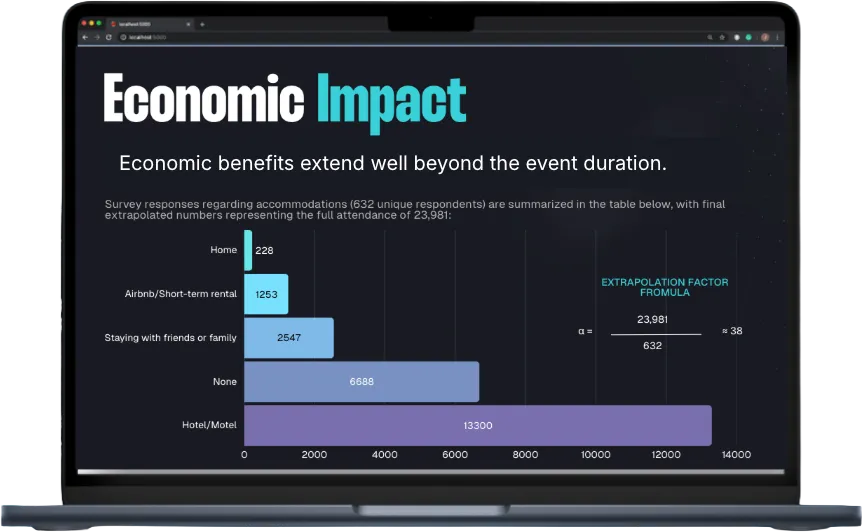





You need to prove your tournament generated real economic impact to secure next year's funding, but traditional surveys rely on families remembering their spending weeks after they leave. That memory decay turns your impact report into guesswork, and city councils know it. The future of sports event measurement replaces recall-based surveys with geolocation tracking that captures actual visitor movements in real time. When you layer location data showing hotel stays and restaurant visits with survey responses about spending amounts, Convention and Visitor Bureaus (CVBs) get defensible numbers that can warrant future grants without questioning whether families remembered correctly.
Executive Summary:
- Geolocation data captures actual visitor movement patterns that surveys miss due to memory decay
- CVBs require both direct spending verification and multiplier methodologies like IMPLAN for grants
- Youth sports generated $52.2 billion in travel spending versus spectator sports' $47.1 billion in 2023
- Automated systems built into event software eliminate tens of thousands in consultant costs per study
- Fastbreak Pulse merges survey responses and location tracking to deliver verified economic impact reports
Youth Sports Tourism's Growing Economic Significance
Youth sports tournaments have overtaken professional spectator events as regional economic drivers. In 2023, youth and amateur sports generated $52.2 billion in travel-related spending, compared to spectator sports' $47.1 billion.The gap stems from duration and volume. Professional games draw single-day crowds. Youth tournaments bring families for multi-day weekends, three nights of hotel bookings instead of same-day drives home. Those extended stays mean more restaurant spending, retail purchases, and ancillary transactions.

For mid-sized cities competing for tournament bids, this changes facility investment calculations. A regional soccer complex hosting 20 weekend tournaments per year can drive more economic activity than a single professional franchise exhibition game.
That scale makes accurate measurement critical. When a CVB bases a $100,000 grant decision on projected economic impact, the gap between estimated and documented spending can determine whether future funding gets approved or eliminated.
Why Traditional Survey Methods Fail to Capture Real Economic Impact
Post-event surveys have been the default method for measuring sports tourism impact for decades, but they carry a fundamental flaw: memory decay. When you ask families what they spent two weeks after a tournament ends, you're getting approximations at best. Did they eat at two restaurants or three? Was that hotel $120 or $140 per night? Most can't recall with precision.
The cost compounds the problem. Traditional event-specific surveying requires hiring consultants, distributing paper forms, and manually processing responses. For small communities hosting regional tournaments, that expense often makes impact measurement financially impractical. So they skip it entirely or rely on rough multipliers that city councils rightfully question.
In 2021, sports tourism generated $39.7 billion in direct spending that led to a total economic impact of $91.8 billion. With stakes that high, guesswork doesn't cut it anymore when CVBs need defensible numbers to secure future grants.
How Geolocation Data Changes Visitor Tracking Accuracy
Geolocation data tracks actual movement patterns through GPS signals. When an attendee carries their phone to an event, that device creates a location trail showing their origin city, hotel check-in, restaurant stops, and shopping visits. This approach captures what surveys miss: the full trip footprint. You can see that a family drove four hours from out of state, stayed three nights at a specific hotel chain, ate dinner at local restaurants each evening, and stopped at a retail district on their way home. That level of detail lets cities quantify exactly which businesses benefited and how far the economic ripple extended.
The verification matters when grant funding is on the line. CVBs use this data to base their grant decisions on documented visitor flows instead of participant memory. The table below provides an overview of the different ways to measure event impact and how that is handled through traditional surveys and geolocation-based tracking.
Real-Time Data Collection Through Mobile Event Apps
Mobile event apps create a natural data collection point where parents check game times and scores while generating timestamps, location markers, and engagement patterns. No surveys required. This first-party data arrives in real time, not weeks after the event. You can see peak attendance windows, which venues drew the most traffic, and how long families stayed on site. That behavioral data reveals spending opportunities survey respondents would never think to mention. So when families pull up schedules and live scores, CVBs get verified foot traffic data showing when visitors arrived, how many days they stayed, and which local businesses they visited. Both sides win without adding friction to the experience.
Combining Multiple Data Sources for Verified Spending Patterns
Geolocation data shows where visitors went. Survey responses reveal what they spent. Layering both datasets together lets you verify claimed spending against actual location patterns.
Here's why that cross-reference matters: if survey respondents report $8,000 in restaurant spending but geolocation shows only 40% of attendees visited dining establishments, the numbers don't align. That discrepancy flags either inflated self-reporting or incomplete tracking. With both signals, you can adjust the model to reflect reality instead of accepting either source as absolute truth.
This dual-method approach catches what single-source tracking misses:
- Geolocation can't tell you how much someone spent at a restaurant, only that they visited.
- Surveys capture dollar amounts but suffer from recall bias.
Together, they produce verified spending patterns that can substantiate the economic value cities need to warrant future grants.
What CVBs Actually Require in Economic Impact Reports
CVBs reviewing grant applications expect two things: recognized methodologies and third-party validation. The methodology you choose depends on who's reading the report:
- National Income Accounting tracks direct spending through actual transaction data and visitor surveys. This approach works well for city councils and finance departments because it shows verifiable dollars flowing into local businesses. When a Destination Marketing Organization (DMO) needs to make a case for allocating $50,000 to a sports complex upgrade, showing $2 million in documented hotel and restaurant receipts carries more weight than theoretical multipliers.
- Keynesian multipliers (like [IMPLAN] or RIMS II models) estimate the ripple effect when that initial spending circulates through the local economy. These models are academically accepted and government-recognized, but they require clean input data. Garbage in, garbage out.
In most cases, CVBs want both: verified direct spending from the first method, then multiplier modeling to show total economic impact. That combination gives grant reviewers the documented receipts they need to warrant funding decisions while showing the broader community benefit that makes those investments politically defensible.
From Manual Estimates to Automated Impact Intelligence
Traditional impact studies rely on hiring consultants who distribute post-event surveys, wait for responses, and spend weeks building models. That lag pushes your report weeks past deadlines, after city officials have already reviewed grant applications or facility funding requests. The consultant model also prices out smaller operators. A credible economic impact study from a recognized firm costs between $15,000 and $30,000 per event. For regional tournament directors running two or three events annually, that expense isn't feasible. So they submit grant requests with no impact data, or use rough estimates that reviewers dismiss.
Automated systems built into event software change that calculation. When data collection happens through the same software managing registration and scheduling, there's no separate survey deployment, no consultant engagement, and no multi-week processing delay. The impact report generates automatically because the data was already captured during operations.
How Fastbreak Pulse Delivers Verified Economic Impact Data
Fastbreak Pulse merges survey responses and geolocation tracking into one reporting system. First-party data from the Fastbreak AI app captures family spending. Location tracking confirms where visitors went. Both feed into impact models built for CVB requirements. Reports generate after each event because data collection runs during operations. You get visitor origin data, spending patterns, and total economic impact calculated through standard multiplier methodologies.
For CVBs reviewing grant applications, that documentation closes the loop. They see out-of-state visitor counts, which hotel properties filled rooms, and direct spending in local businesses. Those defensible numbers help secure future grants without waiting weeks for consultant reports or relying on memory-based surveys that city councils question.
Final Thoughts on Economic Data That Secures Funding
Securing grants depends on documentation that survives city council scrutiny, and the future of sports event measurement delivers that without manual surveying. Your tournament software can capture spending patterns and visitor flows as they happen, not weeks after families head home. That real-time approach gives CVBs the verified numbers they need while you keep your focus on running tournaments that bring families back.
FAQ
How does geolocation data track visitor spending more accurately than surveys?
Geolocation data captures actual movement patterns through GPS signals, showing where visitors traveled from, which hotels they stayed at, and which restaurants and shops they visited. When layered with survey responses about spending amounts, you get verified patterns instead of relying solely on memory-based estimates that fade weeks after an event ends.
What methodologies do CVBs require in economic impact reports?
CVBs expect recognized approaches like National Income Accounting (which tracks direct spending through transaction data) and Keynesian multipliers such as IMPLAN or RIMS II models (which calculate ripple effects through the local economy). In most cases, they want both: documented direct spending to substantiate the initial investment and multiplier modeling to show total community benefit.
Why has youth sports tourism overtaken professional events as an economic driver?
Youth tournaments bring families for multi-day weekends with three nights of hotel bookings, while professional games typically draw single-day crowds. In 2023, youth and amateur sports generated $52.2 billion in travel-related spending compared to spectator sports' $47.1 billion, driven by extended stays that produce more restaurant spending and retail purchases.
How much does a traditional economic impact study cost?
A credible economic impact study from a recognized consulting firm typically costs between $15,000 and $30,000 per event. That expense prices out smaller tournament operators running two or three events annually, forcing them to submit grant requests with no impact data or rough estimates that reviewers question.
What data sources does Fastbreak Pulse combine for impact reporting?
Fastbreak Pulse merges first-party survey responses from the Fastbreak AI app with geolocation tracking to create one reporting system. Survey data captures spending amounts while location tracking confirms where visitors went, feeding both signals into impact models built for CVB requirements that generate reports after each event.


