



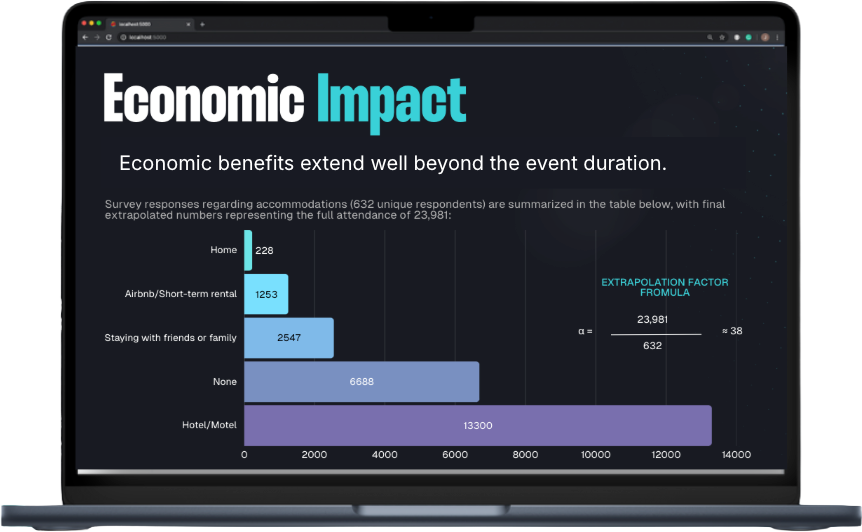




Building schedules for multi-venue tournaments means juggling dozens of constraints: field availability, referee assignments, rest periods, and coaching conflicts. Multi-venue scheduling software handles all of that at once using mathematical optimization instead of manual adjustments. You input your requirements, and the system generates a conflict-free schedule in minutes. The gap between basic and advanced scheduling tools, though, shows up at scale. Simple software prevents double bookings but can't balance travel costs, venue utilization, and competitive fairness across hundreds of teams. Optimization algorithms solve for all those variables simultaneously to produce schedules that reduce costs and improve the experience for everyone involved.
Exec Summary:
- Mathematical optimization scheduling solves for thousands of variables at once vs. basic tools that fix conflicts one at a time
- Fastbreak AI uses the same constraint programming engine that schedules the NBA, NHL, and MLS for amateur tournaments
- Integrated systems eliminate manual data transfers between registration, housing, ticketing, and scheduling modules
- Revenue stacking through housing rebates and mobile ticketing
- Fastbreak AI schedules 1,000 teams across multiple venues in minutes with automatic weather delay rescheduling
What is Sports Scheduling Software For Youth Tournaments?
Sports scheduling software automates tournament and league schedule creation. You input teams, venues, and time slots. The software generates a conflict-free schedule in minutes. Most amateur tournaments involve hundreds of teams across multiple fields or courts. The sports scheduling software manages venue availability, referee assignments, rest periods, and coach conflicts without manual intervention.
The difference between basic and advanced scheduling tools is mathematical. Simple tools to prevent double bookings using if/then logic. AI sports scheduling uses mathematical optimization to balance multiple constraints at once, producing schedules that reduce travel time, maximize venue utilization, and maintain competitive balance across divisions.
A sports league spreads its schedule across months. A youth tournament compresses the same kind of complexity into two or three days. Hundreds of teams, dozens of fields, rest requirements, division balance, and travel all have to line up across a single weekend, with no chance of fixing a mistake on Monday. That's why scheduling matters more for youth tournaments. A league scheduler has weeks to work a problem out. A tournament director has hours (or minutes). Using AI for sports scheduling closes that gap, putting the same optimization the world's biggest leagues rely on in the hands of operators working on a weekend timeline.
How We Compared Sports Scheduling Software Platforms
We assessed scheduling software on the following criteria:
- First, on how it solves the core problem: creating conflict-free schedules at scale. The algorithm matters most. Does it use simple rule-based logic that breaks down with complexity, or does it solve for multiple constraints simultaneously through mathematical optimization?
- Second, we assessed integration depth. Can the scheduler pull team data directly from registration? Does it communicate with housing and ticketing systems?
- Third, we also looked at multi-venue coordination, constraint handling for coach conflicts and rest periods, real-time adjustment capabilities for weather delays, and whether the software helps generate revenue beyond schedule creation.
We rely on publicly documented capabilities and verifiable client usage.
Best Overall AI Sports Scheduling: Fastbreak AI
Fastbreak runs on the same mathematical optimization engine that creates the schedules for the NBA, NHL, and MLS. The company's AI team includes PhDs in optimization, mathematics and data engineering who have built constraint programming that solves for thousands of variables at once: competitive levels, travel distance between venues, rest time, play surface capacity, and coaching conflicts. Tournament directors get the mathematically optimal schedule in minutes, not ours. The engine can handle 1,000s of teams across dozens of venues for multi-day events. Bracket generation, pool play configuration, and blackout windows are generated automatically and published on a tournament website. Weather delays or team cancellations trigger one-click rescheduling that preserves competitive balance across the bracket.
The scheduler sits inside a unified tournament management platform. The same database powers housing management, mobile ticketing, AI photography, and economic impact tracking. When a team registers, hotel block requirements update automatically. A schedule change instantly pushes to ticketing gates and the consumer app. No manual syncing between disconnected tools. Most scheduling software uses basic heuristics that fail at scale. Fastbreak AI solves across all constraints at once to balance rest, minimize travel, and maximize facility usage.
GotSport
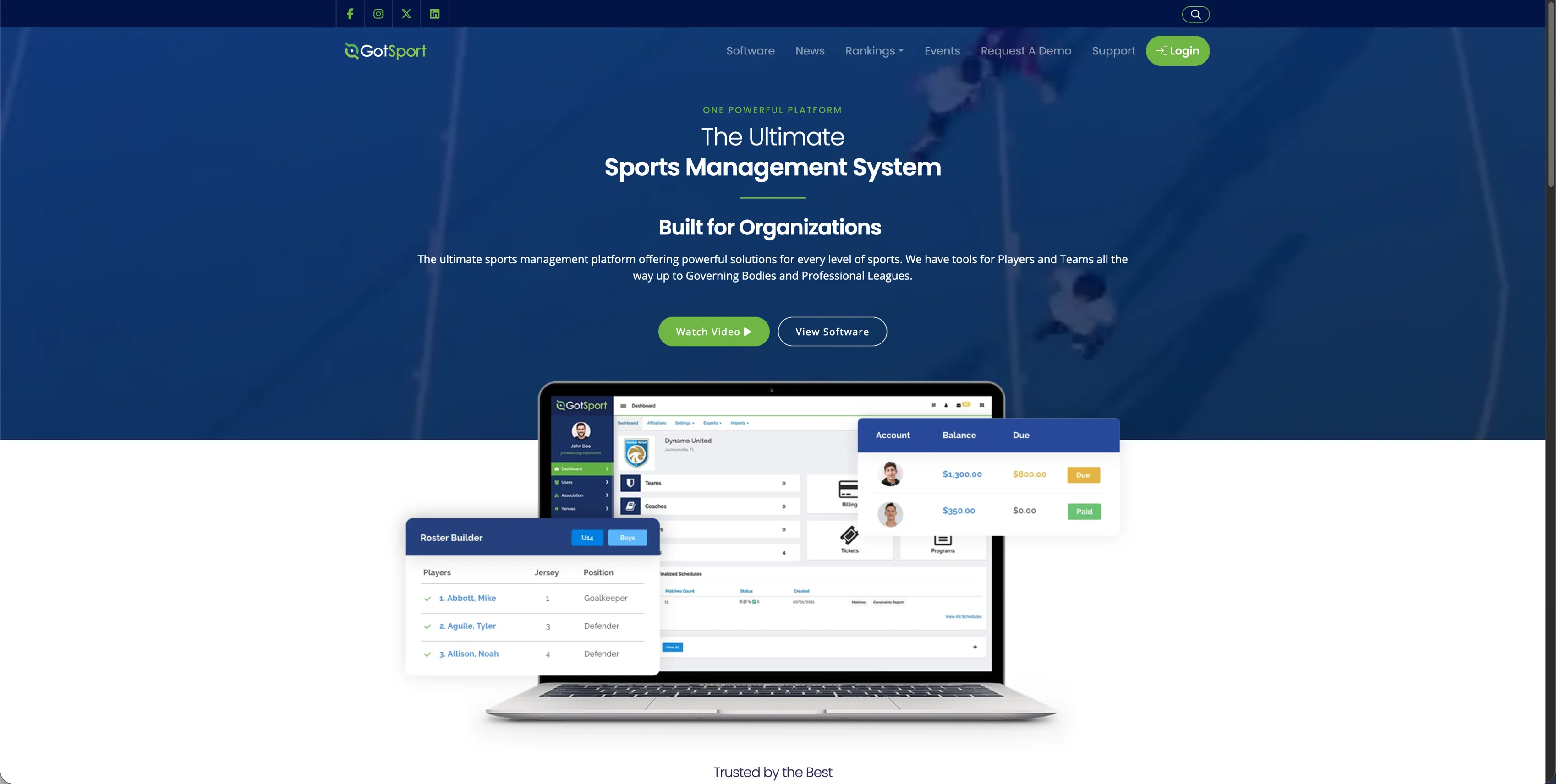
GotSport handles player registration and roster verification for state soccer associations. Many states require it for sanctioned competitions. It solves the registration compliance problem for soccer organizations operating under state association rules.
Key Features
GotSport offers a number of key features for sports scheduling in amateur tournaments:
- Player registration with birth certificate and waiver verification workflows that meet state governing body requirements
- Digital player card generation for sanctioned competitions with automatic roster compliance checks
- Integration with state association databases for eligibility tracking across seasons
Limitations
The scheduling gap is substantial. No constraint programming for multi-venue optimization. No AI-driven travel balancing or rest period algorithms. Bracket generation uses basic templates without mathematical optimization for venue capacity, field availability, or referee assignment patterns.
The Bottom Line
If you need state-mandated registration, GotSport fills that role. For tournament scheduling that accounts for travel cost reduction, venue utilization rates, or revenue optimization across multiple sites, you're building a separate workflow.
SportsEngine
SportsEngine bundles multiple acquired brands: HQ, Tourney Machine, and NCSI. You get registration, website hosting, and background checks under one vendor, but each product runs independently.
Key Features
SportsEngine offers a number of key features for sports scheduling in amateur tournaments:
- Team and league registration through SportsEngine HQ for basic roster and payment collection needs
- Background check services through the NCSI acquisition for volunteer and coach compliance
- Website hosting that gives leagues and clubs a templated web presence without custom development
- Bracket scheduling through Tourney Machine for single and double elimination formats
Limitations
The tradeoff is data flow. Registration in HQ, scheduling in Tourney Machine, and background checks in NCSI don't share information automatically. Scheduling relies on standard bracket logic, not mathematical optimization, so multi-venue tournaments with constraint layers need manual fixes. No housing compliance tracking or mobile ticketing with sponsor revenue tools.
SportsEngine offers width through acquisitions but lacks the unified codebase and optimization algorithms purpose-built for tournament revenue.
The Bottom Line
Works for leagues that need registration and hosting together and can work around disconnected systems.
TeamSnap
TeamSnap coordinates practice schedules and parent communication for individual teams. You get messaging, availability tracking, and carpool organization for rec league coaches managing one roster.
Key Features
TeamSnap offers a number of key features for sports scheduling in amateur tournaments:
- Team messaging and availability tracking that lets parents confirm who's showing up to practice or Saturday's game
- Practice schedule coordination with parent polling so coaches can pick times that work for most families
- Snack duty and carpool organization built for volunteer management at the team level
- Photo sharing galleries where parents post game highlights and team photos
Limitations
TeamSnap doesn't have any league-wide scheduling engine. No multi-venue optimization. No bracket generation or constraint programming for tournaments. Data stays siloed at the team level with no aggregate reporting across divisions or financial dashboards.
The Bottom Line
You coordinate carpools. You don't schedule 500-team events with housing compliance and integrated ticketing revenue. TeamSnap is good for single-team managers who need parent coordination tools.
SportWrench
SportWrench serves volleyball tournaments. The scheduling engine generates brackets and pool play formats built around volleyball rotation patterns. You get referee assignment tools specific to volleyball officiating workflows and spectator admission processing at the gate.
Key Features
SportWrench offers a number of key features for sports scheduling in amateur tournaments:
- Volleyball bracket and pool play generation with scoring workflows designed for rotation rules
- Spectator admission fee collection at entry points with daily and multi-day pass options
- Referee scheduling calibrated to volleyball officiating needs and court assignment logistics
Limitations
SportWrench has a rigid sport specialization. The scheduling logic assumes volleyball workflows and doesn't adapt to basketball, soccer, or lacrosse without manual workarounds. No constraint programming that optimizes across multiple sports simultaneously.
The Bottom Line
Works for tournament directors who run volleyball-only events and need basic bracket publishing with gate revenue collection.
Why Fastbreak AI Is The Best Sports Scheduling Software For Amateur Tournaments
Fastbreak AI runs on the same constraint programming that schedules professional leagues. The difference is how the system is built: competitors connect separate registration, housing, and scheduling tools that need manual data transfers between them. Fastbreak uses one unified codebase where every module pulls from the same real-time database.
When weather forces a schedule change, you adjust once. The update flows to hotel rooming lists, ticketing gates, and the consumer app instantly. No spreadsheet exports. No copy-pasting between systems.
The math matters because tournament complexity scales exponentially. A 100-team event with 3 venues and 15 time slots creates millions of possible schedule combinations. Heuristic tools test a few thousand options and pick the least-bad result. Mathematical optimization assesses all valid solutions simultaneously to find the best outcome for travel, rest, and venue usage.
Fastbreak can also help you generate revenue.
Final Thoughts On Tournament Scheduling Technology
You can keep patching together separate tools for registration, housing, and brackets, or you can use multi-venue scheduling software built on one database that updates everything at once. The second option costs less to operate and generates more per event. If your current system requires manual exports between modules, you're paying twice for half the result.
FAQ
How Do I Choose The Right Sports Scheduling Software For My Tournament?
Start with the algorithm. If you're running multi-venue events with more than 50 teams, you need mathematical optimization that solves for travel, rest, and venue capacity simultaneously. Rule-based tools break down at that scale. Then check integration depth: does the scheduler connect directly to registration, housing, and ticketing, or will you manually sync data between disconnected systems?
Which Scheduling Software Works Best For Single-Sport Tournaments Versus Multi-Sport Events?
Single-sport tools like SportWrench optimize for volleyball-specific workflows but can't adapt to basketball or soccer without manual workarounds. If you run multiple sports or plan to expand beyond one, pick software built on constraint programming that handles different sport rules and venue types without requiring separate systems for each.
Can Scheduling Software Actually Generate Revenue For My Tournament?
Yes, but only if it includes housing management, mobile ticketing, and sponsor tools in the same system. Software that only creates schedules is a cost center.
What Is The Difference Between Heuristic Scheduling And Mathematical Optimization?
Heuristic tools use if/then rules to prevent double bookings but solve conflicts one at a time. Mathematical optimization assesses all constraints at once (travel distance, rest periods, venue capacity, coaching conflicts) to find the best possible schedule across the entire tournament. The difference matters when you're coordinating hundreds of teams across multiple venues.
How Long Does It Take To Reschedule A Tournament After A Weather Delay?
With rule-based systems, you're manually adjusting brackets and notifying teams through separate communication tools, which can take hours. AI sports scheduling with real-time adjustment capabilities regenerates the entire schedule in minutes while preserving competitive balance, then pushes updates instantly to housing, ticketing, and the consumer app.


