







Sit with this for a moment.
Generative AI can build, design and launch a full digital marketing campaign in seconds. Programmatic advertising can reach tens of millions of targeted consumers before your morning coffee gets cold. Social platforms offer audience segmentation so precise that you can find left-handed golfers in Scottsdale who recently bought trail mix.
And yet, some of the smartest brand teams in the country are loading up activation tents, hiring brand ambassadors, and spending serious budgets at music festivals, college campuses, and youth sports tournaments.
This is not nostalgia. It's a strategic response to something the data has been saying for several years, and that senior marketers are finally taking seriously: digital advertising is getting harder to trust, harder to cut through, and harder to connect to revenue, especially with the two consumer cohorts that will define your brand’s next decade.
The Trust Problem Nobody Budgeted For
Before we talk about what experiential marketing is and why the numbers behind it are compelling, we need to talk about the environment your ads are landing in right now.
The Edelman Trust Barometer, one of the most cited annual studies of consumer sentiment, reports that 56% of consumers now distrust advertising as a category. Not a specific ad. Not a specific platform. Advertising itself. More than half of your potential customers have already decided, before your creative renders, that they probably should not believe it.
That erosion did not happen overnight, and artificial intelligence is accelerating it. A 2025 survey by Ping Identity of 10,500 consumers found that while more than two-thirds of people now use AI tools regularly, only 17% fully trust organizations to manage their personal data responsibly.
“Consumer confidence in brands is eroding as we enter a ‘trust nothing’ era fueled by AI-enabled fraud.” — Darryl Jones, VP Consumer Segment Strategy, Ping Identity
The youngest consumers feel this most acutely. A 2025 consumer survey by Checkr found that 80% of Gen Z now regularly question the authenticity of digital visuals, and 67% have doubted whether influencers or social media profiles they follow are genuine. The generation that grew up entirely online has become the most skeptical audience.
The IAB, in partnership with Sonata Insights, published research in early 2026 that should stop any AI-heavy creative strategy in its tracks. Among Gen Z consumers, 30% describe brands that use AI for advertising as “inauthentic,” 26% as “disconnected,” and 24% as “unethical.” For context, Millennials applied those same labels at rates of 13%, 8%, and 8%, respectively. The younger the consumer, the more corrosive AI-generated content feels to them.
And they act on it. Morning Consult found that 18% of Gen Z adults stopped shopping with a brand in the past year, specifically because they did not trust how the brand was using AI. That number will not go down.
The Myth of the Digitally Available Gen Z Consumer
Here is where the planning assumptions break down.
Yes, Gen Z is online constantly. Deloitte’s 2025 Digital Media Trends report shows that consumers spend nearly 7 hours a day with media. 90% are social media users. They use TikTok as a search engine. All of that is true.
But here is what that data obscures: Gen Z online is not Gen Z in a group. It is Gen Z alone, earbuds in, scrolling a personalized feed in a bedroom, on a bus, or in a waiting room. The internet did not create a generation of joiners. It created a generation of individuals navigating an infinite, fragmented, largely private media experience.
// Gen Z online is not Gen Z in a group
Finding them in a shared physical space, present and engaged with people around them, is genuinely difficult. They are not at the mall. They are not watching appointment television. They are not gathered around a platform you can buy. The places where Gen Z still shows up in groups, reliably and with full attention, are events: concerts, sports, competitions, campus activities, and local gatherings centered on something they care about.
That creates a real problem for brands built on reach and frequency through digital channels. And it creates a real opportunity for brands willing to show up in the physical world.
Research from the Barna Group found that 54% of Gen Z strongly agree that in-person relationships are more valuable than digital ones. Despite everything the internet offers them, they know the difference between a real interaction and a simulated one. So do their parents.
What Experiential Marketing Actually Is
Experiential marketing is not a stunt. It is not a sampling table outside a grocery store, though that is one form of it. At its best, experiential marketing creates an environment where a consumer can interact with your brand directly, in a context that matters to them, and leave with a memory attached to your name.
A brand activation at a youth sports tournament. A product introduction at a campus event. A sampling program at a regional festival. A hands-on demonstration where someone tries your product, talks to a real person, and associates your brand with a moment they actually experienced. The goal is not impressions. It's to leave an emotional imprint.
Some brands have already figured this out. Global spending on experiential marketing reached $128.35 billion in 2024, surpassing pre-pandemic highs for the first time, according to PQ Media research. Seven out of ten Fortune 1000 marketers are increasing their experiential budgets in 2025. B2C companies alone spent $90.3 billion on it last year, a 10.3% increase over 2023.
Nine out of ten consumers say they are more likely to purchase from a brand after participating in a brand activation. Not after seeing an ad. After participating. (G2, 2025)
Why It Works Differently on Gen Z and Gen Alpha
The $1.2 trillion question. That is what Gen Z will control in purchasing power by 2030. Gen Alpha, currently 12 and under, follows close behind and will represent the largest consumer generation in history.
A 2024 NielsenIQ survey of 30,000 global respondents found that Gen Z places 2.7 times more weight on brand values and actions than Gen X or Boomers. They are not passive recipients of a message. They are active evaluators of whether your brand deserves to be in their lives.
What moves them is authenticity, and, by definition, authenticity cannot be manufactured by an algorithm. Research by SAP Emarsys found that 28% of Gen Z specifically seek out brands that provide memorable experiences, an 11% jump over older generations. The same study found that nearly half of Gen Z consumers have abandoned a brand simply because they grew bored with it.
The in-person environment addresses both problems at once. It is inherently real. A brand ambassador who hands your product to a 16-year-old at a tournament, answers their questions, and creates a genuinely good moment has done something no content calendar can replicate. That interaction is not suspected of being AI-generated. It is not skippable. It is not competing with 400 other pieces of content in a feed. It is just a person and a brand, in a real place, having a real moment.
And it spreads. Research consistently shows that nearly all attendees at experiential events share their experiences on social media afterward. The live event becomes the source of user-generated content that Gen Z actually trusts because it comes from people like them, not a brand’s content studio.
The Case for Adding Experiential As A Channel
If you are a VP of Marketing for a consumer brand weighing this against your current mix, here is the straightforward version.
Digital advertising is efficient at scale but increasingly untrustworthy. Experiential marketing is less efficient at scale and remarkably effective at trust. For most consumer brands, the right answer is not one or the other. It is a deliberate balance that uses experiential to build the emotional foundation that makes digital perform better.
The entry point is simpler than most marketers expect. You don't need a multi-city activation or a production budget that requires a board presentation. You simply need to ask two questions: "Where does my target consumer gather, in person, and what would make a brand interaction there feel welcome rather than intrusive?"
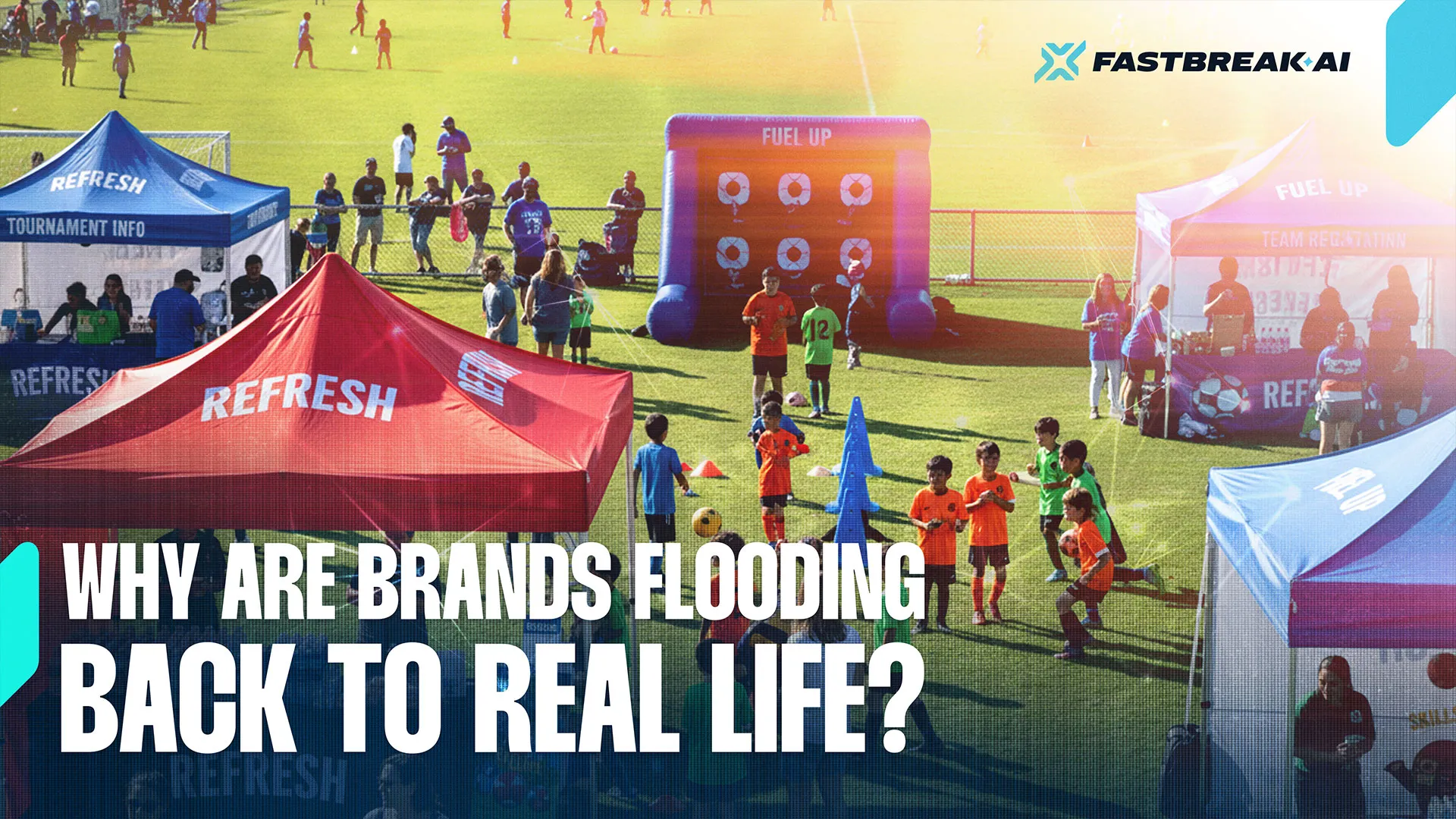
For brands targeting teens and families, youth sports events are among the most accessible and underutilized entry points for experiential marketing. There are more than 600,000 youth leagues in the United States. Over 30 million kids compete on three million teams. Their families spend an estimated $39 billion a year on youth sports. And every weekend, in every mid-sized city in this country, those families are gathered on a field, court, or gym floor in a way they are not gathered anywhere else.
You can be there. Most of your competitors are not.
The internet promised everything. Reach at scale, targeting at precision, measurement at granularity. It delivered a lot of that. What it did not deliver was trust. And for the two generations who will define consumer markets for the next 30 years, trust is not a soft metric. It's a deciding factor in 81% of consumers' purchase decisions globally.
The brands building that trust right now are not doing it in a feed. They are doing it in person, at events, one real interaction at a time.
Fastbreak AI connects consumer brands with athletes, teens, and families at youth sports events nationwide through Fastbreak Connect, a turnkey experiential activation program. Learn more at fastbreak.ai/connect.
FAQs
How much do consumers distrust advertising today?
The Edelman Trust Barometer reports that 56% of consumers now distrust advertising as a category, not a specific ad or platform. That erosion is accelerating with AI: a 2025 Ping Identity survey of 10,500 consumers found only 17% fully trust organizations to manage their personal data responsibly, despite widespread AI tool use.
Why is Gen Z especially skeptical of AI-driven advertising?
A 2025 Checkr survey found 80% of Gen Z regularly question the authenticity of digital visuals, and IAB and Sonata Insights research found 30% of Gen Z describe brands using AI for advertising as inauthentic, compared to just 13% of Millennials. Morning Consult also found 18% of Gen Z adults stopped shopping with a brand in the past year specifically due to distrust in its AI use.
How much has spending on experiential marketing grown?
Global experiential marketing spending reached $128.35 billion in 2024, surpassing pre-pandemic highs for the first time, according to PQ Media. B2C companies alone spent $90.3 billion on it that year, a 10.3% increase over 2023, and seven out of ten Fortune 1000 marketers planned to increase experiential budgets in 2025.
Does experiential marketing actually drive purchases?
According to G2 research from 2025, nine out of ten consumers say they are more likely to purchase from a brand after participating in a brand activation, as opposed to simply seeing an ad. A 2024 NielsenIQ survey of 30,000 respondents also found Gen Z places 2.7 times more weight on brand values and actions than Gen X or Boomers.
Why are youth sports events an effective venue for experiential marketing?
There are more than 600,000 youth leagues in the United States, with over 30 million kids competing on three million teams and families spending an estimated $39 billion a year on youth sports. These eventsain one of the few remaining places where teens and families reliably gather in person and with full attention, making them an accessible and largely underutilized entry point for brands.


