





Brand loyalty in consumer behavior today reflects something most operators miss: the families who attended your tournament once and never came back rarely tell you why. They filled out a registration form that asked too many questions, received no update when the schedule changed and walked to the wrong gym, then spent an hour tracking down a hotel room block that should have taken five minutes to book. None of those moments produced a complaint. In most cases, they produced a quiet decision to register somewhere else the following spring, and by the time that gap shows up in a report, the habit is already formed. So, understanding what actually drives families to return, and what quietly pushes them away, is where retention work begins.
Executive Summary
- Repeat registration is the real signal: a family who comes back the following season, without being prompted, has moved past convenience and into genuine loyalty.
- Retention is built during the weekend itself, not in a follow-up email: the check-in, the schedule update, the housing experience are the moments families carry home.
- Reliable operations are the primary driver of repeat attendance; confusion at any single touchpoint is enough to send families quietly toward a different organizer the next season.
- Community and recognition compound over time: families who feel seen (returning-attendee acknowledgment, clear communication, frictionless participation) become advocates who bring other teams.
- The metrics that matter are return rate, early-registration conversion, and referral activity; repeat purchases alone don't distinguish loyalty from inertia.
- Fastbreak connects registration, scheduling, and housing into one experience so operators can remove the friction points families remember and build the reliability that brings them back.
Why Repeat Registration Is the Real Measure of a Successful Tournament
Return rate is the number that matters. A family who registers again the following season, without being asked twice, has moved past convenience and into something closer to genuine commitment. A family who doesn't come back rarely explains why.
Most operators track total registrations. Fewer track how many of those registrations came from families who attended the year before. That gap in measurement is where loyalty quietly erodes, because the signals that predict drop-off rarely show up in a single data point. The check-in experience, the schedule update that never came, the housing block that was hard to find: each one is small on its own, and together they form the reason a family quietly registers somewhere else next spring.
Three return behaviors reveal where a family actually stands in their relationship with your event:
- Convenience return, where a family comes back because the event was local, the timing worked, or no better option was visible. It looks like loyalty in a registration report, but it's fragile.
- Preference return, where a family comes back because the experience last time was genuinely better than the alternatives they considered. They had real options and chose your event.
- Committed return, where a family comes back regardless of competing options, registers early, and recommends the event to other teams without being asked.
Most operators get stuck at the first stage without realizing it. In most cases, the families who return for convenience look identical to preference returners in a registration report, until a better option appears.
| Stage | Definition | What Operators Can Do |
|---|---|---|
| Convenience Return | A family comes back because the event was local, the timing worked, or no better option was visible. Looks like loyalty in a report, but dissolves the moment a nearby competing event improves. | Protect the baseline: keep registration simple, schedules accurate, and housing clear. Convenience returners are the first to leave when the basics break down. |
| Preference Return | A family comes back because the experience was genuinely better than the alternatives they considered. They had real options and chose your event. | Build on the baseline with returning-attendee recognition and proactive communication. Families who feel seen when they come back have a reason to choose you over a comparable alternative. |
| Committed Return | A family comes back regardless of competing options, registers early, and recommends the event to other teams without being asked. | Create community touchpoints that give families something to belong to beyond a single weekend. Families at this stage become the referral engine that fills future brackets. |
Putting Returning Teams First
A returning team is worth far more than one registration: they are a predictable, low-friction piece of a competitive market where new-team acquisition carries a steep hidden cost. Retention research puts the cost of recruiting a new team at five to seven times more than keeping a returning one. But the number that rarely appears in an event budget is the hidden cost of unfamiliar teams: the registration questions that arrive the week before the event, the late sign-ups that require bracket revisions, and the last-minute withdrawals that leave gaps no operator can fill cleanly on short notice.
Returning teams skip most of that friction. In most cases, they know the process, register early, and withdraw at a lower rate.
The referral effect adds another layer. A family that had a good experience mentions it. One returning team that brings two others the following season covers a meaningful share of any registration shortfall without additional marketing spend. That compounding is what separates events that grow from events that refill.
Both outcomes, lower operational cost and referral growth, follow from the same moments families remember: a smooth check-in, a reliable schedule update, housing that was easy to book and find. Those are the moments that determine whether a family comes back or starts looking at alternatives next season.
Habit vs. Genuine Preference
Not every returning team is actually committed to your event. Some come back because the timing works, the location is convenient, or nothing noticeably better showed up in their feed. That looks like loyalty in a registration report. It is not.
The gap between habit and genuine preference is invisible under normal conditions. A family who returns out of convenience and a family who returns because they genuinely prefer your event look identical until something goes wrong. A schedule conflict, a venue change, a registration window that opens two weeks later than expected: a habit-return team quietly registers elsewhere. A preference-return team works around the friction, reaches out, and comes back anyway.
That difference matters because habit-based returns are fragile. So, they hold only as long as your event is the path of least resistance.
How Emotional Connection Drives Long-Term Retention
Repeat registration is a signal, but it is not the same as loyalty. The gap between the two is emotional: families who feel genuinely connected to an event stay through registration fee changes, pass on competing events, and recommend the experience without being asked.
According to Harvard Business Review's research on customer emotion and satisfaction, emotionally connected customers deliver higher lifetime value than those who are merely satisfied. So, families who feel genuinely connected to an event deliver more over time (more registrations, earlier sign-ups, and referral activity) than families who are merely satisfied. That connection gets built through accumulated experience, not a single interaction.
A few patterns tend to create it:
- Consistency across every touchpoint reinforces the feeling that an operator understands the family, reducing the mental effort required to trust the next interaction.
- Recognition, whether through tiered returning-team benefits or just remembering a team's prior year, signals that the relationship is mutual, not transactional.
- Shared values give families a reason to return that goes beyond schedule quality or registration cost, a pattern that experiential marketing at youth sports reinforces through repeated in-person connection.
From there, when those elements compound over time, families who leave satisfied become the advocates who bring other coaches in.
The On-Site Moments That Make or Break Return Attendance
Coach Marc Howard ran Romeoville Live across 14 courts with 156 teams and more than 300 games in a single weekend. "We had games running every hour on the hour with no glitches," he said. "Coaches, refs, and spectators all told us how smooth it was. That's the difference great tech makes: it lets us focus on delivering a great experience."
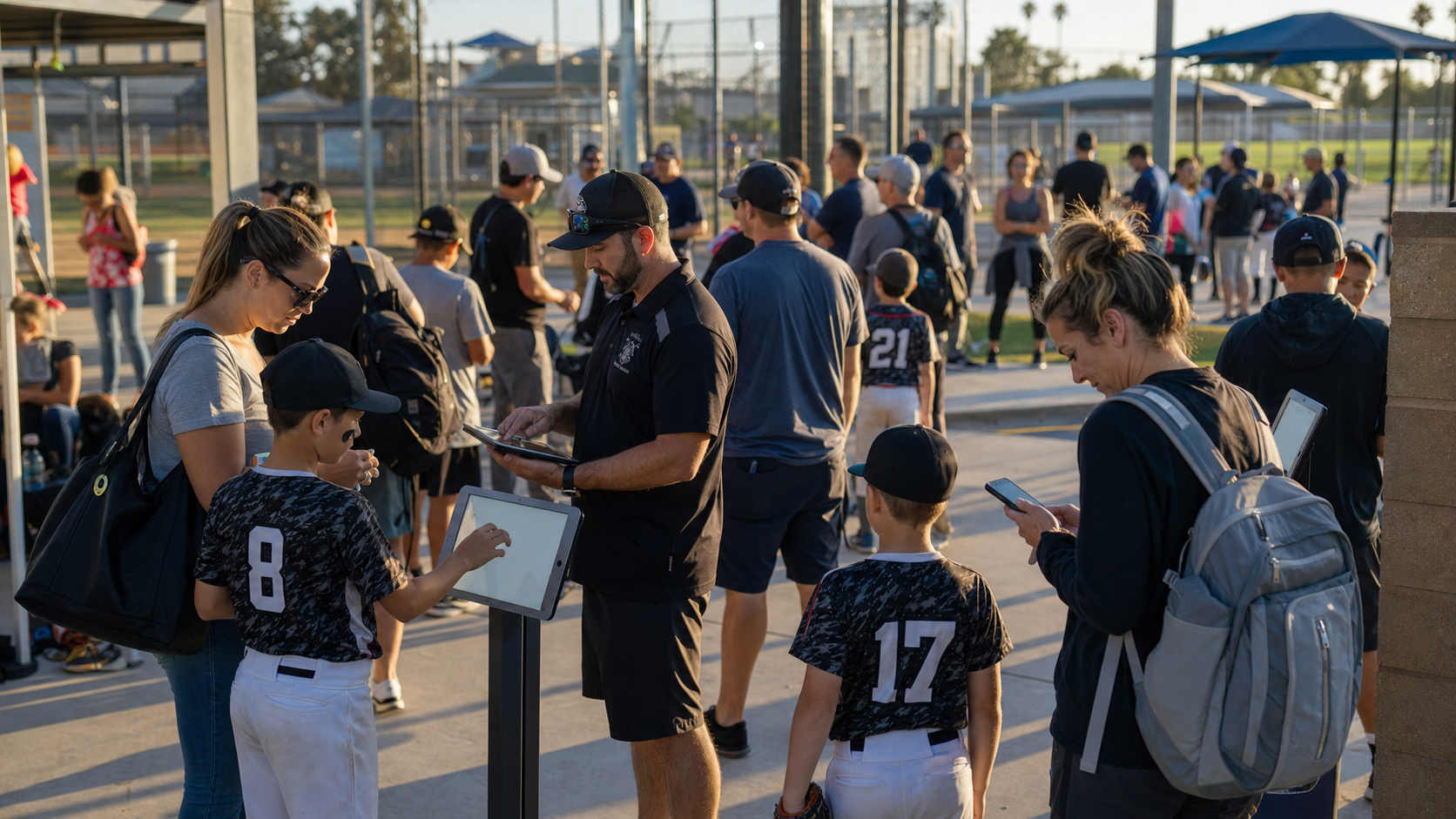
A family's decision to register again forms during the weekend itself. The check-in line that moved in under five minutes, the schedule update that came through on their phone before they walked to the wrong gym, the housing block that was easy to find and book: those details stack up into a feeling families carry home. When those moments go wrong, the feedback rarely arrives in a complaint. Families quietly register somewhere else the following spring.
Four on-site touchpoints carry the most weight:
- Check-in wait times: a line that clears in a few minutes signals that the event was planned for the number of teams that registered. A family that stood for 45 minutes on day one has already logged that before deciding whether to return next year.
- Scheduling reliability with push updates: when a field goes down or a game time changes, a push notification that reaches families before they walk to the wrong gym turns a potential frustration into a non-event. A schedule change that families learn about from another parent in the parking lot is the kind of friction that sticks.
- Returning-team recognition: acknowledging families who are back for a second or third year costs little and signals that the operator notices who comes back. That recognition is what separates preference return from convenience return over time.
- Housing blocks: a block that is easy to find, book, and get around removes one of the most common friction points families carry home from a tournament weekend.
Loyalty at a tournament does not form from one standout moment. It accumulates across many small interactions where the operator either earns trust or spends it. The moments families describe to other coaches in October are the ones that determine whether those coaches register with you the following spring.
Measuring Return Attendance Beyond Registration Totals
Total registrations tell part of the story, but they rarely tell the full one. A family who registers every spring out of habit or geographic convenience looks identical to a genuinely committed family in a registration report. Getting those two apart requires tracking four specific signals: return registration rate, early-registration conversion, post-event recommendation score, and referral activity.
There are several metrics worth tracking together:
- Return registration rate tracks how many of this season's registrations came from families who attended the year before. That number is the clearest read on whether last year's experience was worth repeating.
- Early-registration conversion measures how many returning teams register during the first open window, before reminder campaigns go out. Families who register early without prompting have moved past habit and into genuine preference.
- Post-event recommendation score captures willingness to recommend the event to other coaches and families, which reflects trust built during the weekend itself more than any follow-up survey does.
- Referral activity measures how many new registrations in a given season trace back to a returning family or team. One committed family who brings two others covers a meaningful share of any registration shortfall without additional marketing spend.
No single metric gives the complete picture. That means events with strong total registration numbers but low return rates are often one improved competitor event away from losing a meaningful segment. Tracking these signals together is what separates a genuine read on family loyalty from a flattering one.
Communication Between Events That Reinforces the Decision to Return
The weekend ends, families drive home, and the event fades into the background of a busy fall schedule. Somewhere between September and the following spring registration window, each family quietly decides whether to come back. Most operators have no presence in that window at all.
That gap is where preference-return and habit-return families diverge. So, a family that felt genuinely recognized during the event stays warm toward it. A family that had a fine-but-forgettable experience registers with whoever opens their window first. Between-season communication is what keeps your event in the first category.
Three types of outreach tend to do the most work:
- Early registration announcements sent to returning families before the public window opens. The message is simple: you attended last year and you get first access. That small gesture signals that the operator noticed who came back, and it rewards the families most likely to register anyway.
- Post-event recaps that arrive within a week of the tournament, while the experience is still fresh. A short message that names the event, calls out something specific from the weekend, and links to the next registration window keeps the memory positive instead of letting it fade into a generic impression.
- Schedule announcements timed to when families are making spring plans. A family that already trusts your event will block the dates when they see them. A family that is on the fence will register with whatever event they hear about first. Early communication wins that family before a competitor has a chance to reach them.
Early Registration Incentives and Returning Team Benefits That Work

Structured returning-team benefits are one of the most direct ways to convert first-time attendees into committed repeat registrations, but the gap between a program that builds genuine return behavior and one that hands out generic discounts is wider than most operators expect.
The benefits that bring teams back share a few structural traits:
- Tiered returning-team benefits that grow with a team's attendance history: priority seeding for teams in their second year, and reserved bracket slots for teams in their third year and beyond, give returning families a concrete reason to register early rather than waiting to see what else opens up.
- Early registration windows opened exclusively for returning teams, before the public window launches, signal that the operator noticed who came back and rewards the families most likely to register anyway.
- Recognition tied to actual attendance history, not blanket offers sent to an entire list: a message that names the event, references the team's prior year, and offers something specific to that history carries more weight than a generic discount code. That kind of community membership and recognition is what makes families feel seen.
- Frictionless redemption so the benefit feels worth earning and easy to use, whether that means a pre-filled registration form, a held room block, or an automatic seeding preference applied at sign-up.
Starbucks Rewards is a frequently cited example because it does something most points programs do not: it ties rewards to a customer's actual purchase history rather than offering the same discount to everyone on the list.
In most cases, what separates returning-team benefit programs that build genuine loyalty from those that stall is whether the benefit reinforces the operator's identity or mimics a generic discount scheme. A returning-team benefit should feel like a natural extension of why a family chose your event in the first place: reliability, recognition, and a registration process that respects the history they have with you.
Turning First-Time Visitors Into Loyal Customers at Youth Sports Events With Fastbreak
A check-in line that cleared in five minutes, a schedule update that reached families before they walked to the wrong gym, a housing block that required one booking and no follow-up calls: those are the moments Fastbreak is built around. The platform connects registration, scheduling, and housing into one experience so operators aren't patching together separate systems while families wait. When a team withdraws or a field changes, updates push automatically without a cascade of confused messages. Coach Marc Howard ran Romeoville Live across 14 courts with 156 teams and more than 300 games in a single weekend. "We had games running every hour on the hour with no glitches," he said. "Coaches, refs, and spectators all told us how smooth it was." Nearly 40 percent of teams traveled from outside the Chicago area and booked through pre-arranged room blocks. Families who trusted the event came back and brought other programs with them.
Final Thoughts on Creating Customers Who Return
A check-in that moved, a schedule that held, housing without three phone calls: families carry those details home and make their registration decision based on them. Brand loyalty in youth sports forms in those moments, not in a follow-up email or a discount code. Fastbreak helps operators build each one reliably by connecting registration, scheduling, and housing in one place. Families who trust an event register early, recommend it unprompted, and return year after year. See how reliable operations turn into repeat attendance by reaching out here.
FAQ
Why do teams attend a tournament once and never come back?
Most families who don't return never say why. The friction is usually quiet: a check-in line that ran long, a schedule change they heard about from another parent in the parking lot, a housing block that took three calls to sort out. No single moment is dramatic enough to complain about, but together they form the reason a family registers somewhere else the following spring. The operators who track return registration rate by cohort are the ones who catch those patterns before they compound.
How much does the check-in experience actually affect whether a family comes back?
More than most operators expect. A family that stood in line for 45 minutes on day one has already logged that before they decide whether to return next year. Check-in is the first impression of whether the event was planned for the number of teams that registered. When it moves in under five minutes, it sets a tone that carries through the rest of the weekend. When it doesn't, families carry that friction home and make their registration decision based on it.
What metrics should tournament operators track to measure return attendance?
Four numbers give the clearest picture: return registration rate (how many of this season's registrations came from families who attended last year), early-registration conversion (how many returning teams registered before reminder campaigns went out), post-event recommendation score (willingness to recommend the event to other coaches and families), and referral activity (how many new registrations trace back to a returning family or team). Total registration counts alone won't tell you whether loyalty is building or eroding.
How should operators communicate with families between seasons to keep them coming back?
Three types of outreach do the most work. First, send early registration announcements to returning families before the public window opens, the message signals that the operator noticed who came back. Second, send a post-event recap within a week of the tournament while the experience is still fresh, naming the event and linking to the next registration window. Third, send schedule announcements timed to when families are making spring plans. A family that already trusts your event will block the dates when they see them; one that is on the fence will register with whoever they hear from first.
Which returning-team incentives actually build repeat attendance rather than just offering discounts?
The benefits that bring teams back are tied to actual attendance history, not blanket offers sent to an entire list. Tiered benefits that grow with a team's history (priority seeding in year two, reserved bracket slots in year three) give families a concrete reason to register early. Early registration windows opened exclusively for returning teams, before the public window launches, signal that the operator noticed who came back. Frictionless redemption matters too: a benefit that requires extra steps to claim loses most of its value before the family ever uses it.


