







Most tournament software assumes everyone plays at the same location. That assumption breaks the moment you add a second venue with different capacity limits and availability windows. Running games across multiple facilities face scheduling complexity that single-site tools weren't built to handle. You can't just assign games to venues and hope it works. Travel time between sites, capacity constraints, and facility blackout periods all interact in ways that create conflicts spreadsheets can't predict.
Executive summary:
- Multi-venue sports scheduling creates exponential complexity that spreadsheets can't solve at scale
- AI scheduling engines reduce travel costs and prevent cascading venue conflicts automatically
- Most tournament software uses basic rules that break under real constraint loads across facilities
- Fastbreak AI for tournaments uses the same constraint-solving technology trusted by the NBA, NHL, and 100+ professional leagues
- Better venue allocation cuts hotel nights and charter costs while maintaining competitive fairness
What is Event Management Software for Multi-Venue Sports Leagues?
Multi-venue operations create exponential complexity. A scheduling conflict at one site cascades across every other venue. Manual spreadsheets can't calculate the ripple effects fast enough.
Event management software for multi-venue sports leagues handles a different problem than single-site tournament tools. When you run games across five facilities in three cities over a weekend, you're juggling venue availability windows, field capacity limits, referee assignments, and travel time between sites. These systems coordinate scheduling logic across distributed locations. They allocate games to specific venues based on capacity constraints, prevent double bookings when facilities overlap, and optimize travel routes so teams aren't crossing town multiple times between games. The best ones handle real-time changes when a field floods or a facility closes early, automatically redistributing games without breaking the entire schedule.
How We Ranked Multi-Venue Sports League Management Software
We measured each option against four core requirements:
- Scheduling logic. Can the system handle distributed venue constraints, reduce unnecessary travel between sites, and respect capacity limits? Some tools use basic rules. Others use automated sports scheduling to solve across all variables at once.
- System integration. Scheduling feeds into registration, payments, facility management, and communications. Disconnected systems force manual data work that negates automation.
- Scalability under constraint load. A system that works for 50 teams at two venues often fails at 500 teams across eight facilities. We focused on solutions built to handle complexity without performance drops.
- Multi-venue operations features. Real-time schedule adjustments when facilities close, automated notifications across sites, and venue-specific rule enforcement separate functional software from basic scheduling tools.
Rankings reflect public feature documentation, vendor positioning in professional sports markets, and stated technical capabilities. Sources include vendor product pages and docs, G2 user reviews, SportsTechie market analysis, and direct evaluation of publicly available platform capabilities.
Best Overall Multi-Venue Sports League Software: Fastbreak AI
Fastbreak AI for tournaments calculates the mathematically optimal schedule across venues by solving for tens of thousands of variables simultaneously. The same AI scheduling engine used by the NBA, NHL, and MLS treats venue availability, capacity limits, travel distance, and competitive fairness as interdependent constraints. A venue closure does more than shift one game, the system recalculates the entire event structure to minimize cascading disruptions across all facilities.
Unlike traditional software vendors that charge subscription fees, Fastbreak works as a revenue partner, turning capabilities like ticketing, housing, sponsorships, and scheduling into profit centers that can generate $30,000 to $50,000 or more per event without raising team fees.
Key Features
- AI scheduling engine that solves for venue capacity, travel distance, rest requirements, and competitive fairness in a single calculation
- Real-time schedule regeneration when facilities close or availability changes, automatically redistributing games across remaining venues
- Unified data architecture where venue assignments, travel logistics, and team operations update simultaneously through integrated workflows
- Multi-venue constraint solving that prevents double bookings and optimizes facility usage across distributed locations
- Constraint-solving technology trusted by the NBA, NHL, and 100+ professional leagues worldwide
Limitations
The platform requires organizational commitment to data-driven scheduling instead of manual intuition. Smaller operations running simple single-weekend events at one or two facilities may not need the computational power that Fastbreak provides, making basic bracket tools sufficient for their needs.
Bottom Line
Fastbreak solves the multi-venue optimization problems that other platforms can't calculate. It works for organizations where schedule quality directly impacts running costs, competitive fairness, and participant experience across complex facility networks, delivering the same mathematical rigor that professional leagues require.
SportsEngine
SportsEngine built through acquisitions, not unified architecture. Registration, scheduling, and background checks run on separate systems that don't share data cleanly.
Key Features
- Registration through SportsEngine HQ
- Bracket generation via Tourney Machine
- Background checks from the NCSI acquisition
- Communication tools that operate independently from scheduling and registration workflows
- Pricing varies by module with no transparent all-in-one package rates
Limitations
The acquisition model creates friction. Registration data doesn't flow to Tourney Machine. Scheduling uses simple heuristics that need manual cleanup. When a venue hits capacity or closes, you adjust games by hand because the system can't recalculate across constraints.
Bottom Line
SportsEngine covers youth tournament basics. The fragmented stack and lack of mathematical optimization make it wrong for multi-venue operations where schedule quality drives travel costs and competitive fairness. It works for youth organizations already on SportsEngine who need basic brackets and don't face venue capacity or travel optimization problems.
Playbook365
Playbook365 covers tournament operations with scheduling tools and facility coordination. The platform handles multi-venue logistics through basic assignment features instead of mathematical optimization. It serves amateur tournament directors who need centralized management across distributed facilities.
Key Features
- Tournament scheduling across multiple formats including pool play, brackets, and round-robin competitions
- Housing and facility management tools that track venue assignments and coordinate lodging blocks
- Administrative dashboard for tournament directors to manage registrations and communications
- Multi-venue coordination features that assign games to specific facilities based on availability
- Pricing not publicly available through standard channels
Limitations
The scheduling engine doesn't solve for multiple constraints at once. You can't optimize for venue availability, travel costs, rest requirements, and competitive fairness in a single calculation. The system handles one scheduling input at a time, which works for amateur tournaments but breaks down when every decision affects running costs across multiple facilities. Manual intervention is required when venue conflicts arise or when you need to minimize travel distance between sites.
Bottom Line
Playbook365 handles standard tournament logistics but wasn't built for the constraint-solving complexity that multi-venue operations require at scale. It works for organizers running straightforward tournaments across a few facilities where basic venue assignment meets their needs, but lacks the mathematical optimization necessary to reduce travel costs and solve cascading venue conflicts automatically.
EventConnect
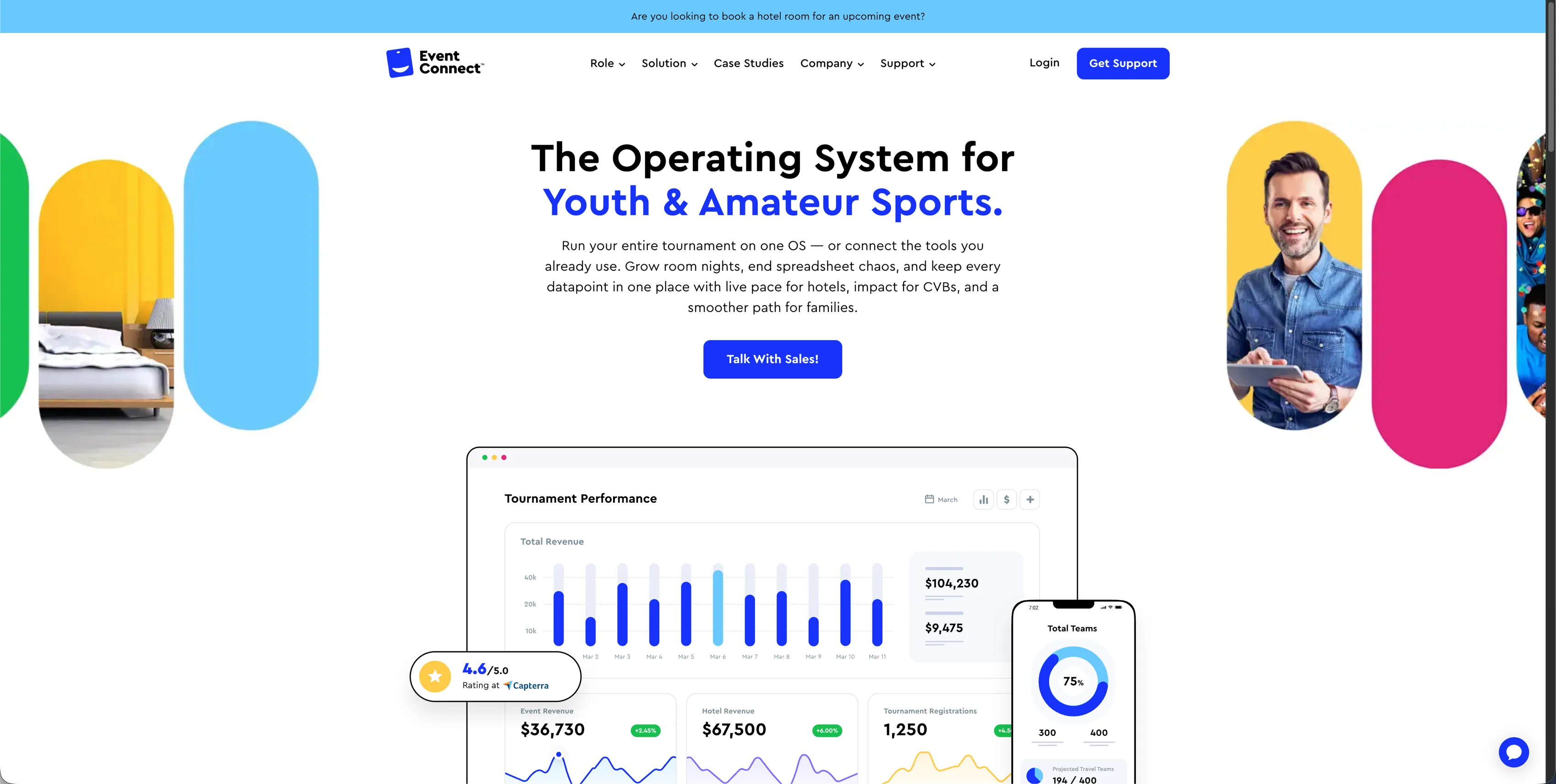
EventConnect handles tournament registration and adds housing compliance on top. It enforces stay-to-play rules but treats travel as an admin task, not a scheduling input. The platform focuses on post-schedule logistics instead of building schedules that reduce travel costs from the start.
Key Features
- Tournament registration with housing compliance tracking that enforces stay-to-play requirements after schedule creation
- Hotel booking integration that connects teams to contracted room blocks through the registration portal
- Compliance reporting tools that verify teams met their lodging commitments before tournament participation
- Travel booking services layered onto the registration system, with no connection to how venues get assigned or games get scheduled
- Pricing remains unpublished through standard vendor channels
Limitations
Housing data lives outside the scheduling engine. Registration and scheduling don't share information, so the platform can't account for where teams are staying when assigning venues or sequencing games. EventConnect verifies compliance after you publish brackets, but it won't help you build a smarter schedule that reduces travel spend in the first place. The platform treats lodging as a separate workflow instead of an input that informs schedule construction.
Bottom Line
EventConnect closes the stay-to-play enforcement gap for organizers who need to fill contracted hotel room blocks and prove compliance. It doesn't solve multi-venue optimization where travel costs and venue assignments shape schedule construction from the beginning, making it better suited for compliance tracking.
Tourney Machine
Tourney Machine provides bracket creation and schedule publishing for tournaments. NBC/SportsEngine acquired the tool years ago, but the underlying scheduling logic hasn't kept pace with the demands of multi-venue league operations.
Key Features
- Drag-and-drop bracket generation with basic venue assignment
- Online schedule publishing that displays brackets and game times
- Mobile-friendly interface for viewing schedules and standings
- Basic pool play and elimination bracket formats for tournament structures
- Contact-based pricing without transparent rate cards
Limitations
The system uses heuristic rules instead of mathematical optimization. Under multi-venue constraints like venue capacity limits, rest requirements, or travel distance, the scheduler breaks down. Directors end up fixing conflicts manually. Even within the SportsEngine product family, Tourney Machine doesn't share data cleanly, creating rework across registration, scheduling, and communication tools.
Bottom Line
Tourney Machine displays brackets but can't solve the optimization problems that define complex league scheduling. It works for small single-weekend tournaments where getting a bracket online quickly matters more than schedule quality, but lacks the constraint-solving capabilities required when venue capacity, travel costs, and competitive fairness all interact across multiple facilities.
Exposure Events
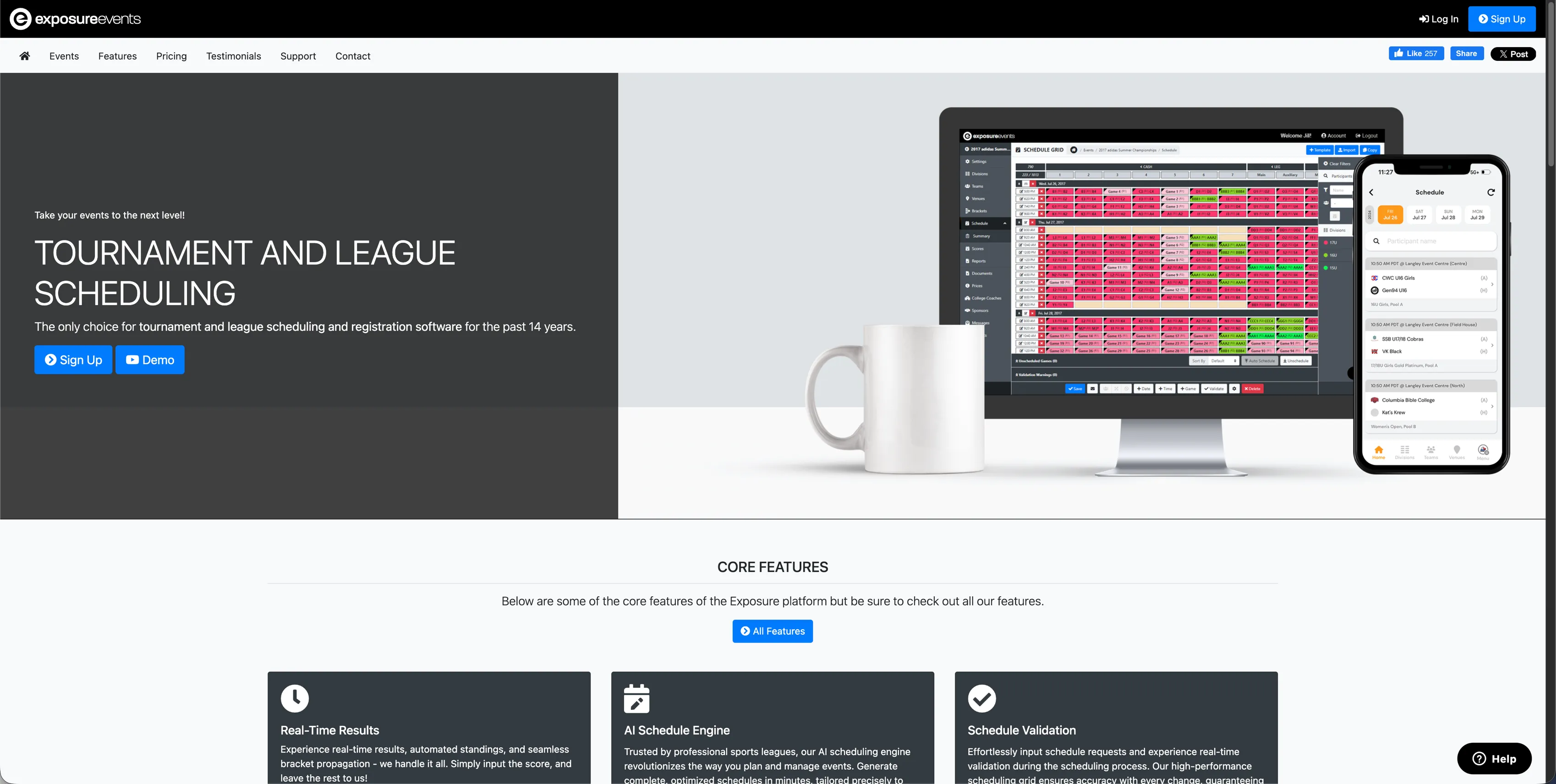
Exposure Events handles grassroots basketball tournaments with NCAA certification tracking. The feature set stops at bracket management and team registration without extending into multi-venue optimization or integrated revenue tools.
Key Features
- Basketball-specific brackets and pool play formats designed for grassroots tournament structures
- NCAA certification tracking for compliance requirements at sanctioned events
- Tournament website builder that displays schedules and standings online
- Sport-specific focus limits the platform to basketball operations only
Limitations
Exposure handles one sport and doesn't extend beyond basic bracket display. You won't find venue optimization logic, travel cost calculation, or integrated revenue platforms like housing management or ticketing. The system displays brackets but skips the administrative and financial infrastructure that multi-venue league management requires. Manual work fills the gaps when you need to coordinate across multiple facilities or generate ancillary revenue streams.
Bottom Line
Exposure covers basketball bracket basics with NCAA tracking for grassroots organizers. It lacks cross-sport flexibility, mathematical optimization, and revenue generation capabilities required for complex multi-venue operations where schedule quality directly impacts travel costs and competitive fairness across distributed facilities.
Feature Comparison Table of Multi-Venue Sports League Software
The table below separates constraint-solving optimization from basic bracket display. Mathematical engines solve across all variables at once. Heuristic tools apply simple rules that require manual cleanup when venue or travel constraints conflict.
Why Fastbreak is the Best Multi-Venue Sports League Management Software
Scheduling is the single biggest lever in tournament management. When scheduling fails, every downstream function (registration, communication, housing, ticketing) suffers regardless of how well other platforms perform.
Multi-venue operations expose the gap between optimization and guesswork. When you schedule across distributed facilities, constraint-based algorithms calculate the interaction between venue capacity, travel distance, and rest requirements that manual methods miss. The difference shows up in your P&L. Better venue allocation cuts hotel nights. Optimized travel routing reduces charter costs. Competitive fairness prevents schedule complaints that damage league reputation. The sports scheduling market increasingly demands this level of computational rigor because amateur leagues now face the same multi-venue logistics that professional operations require.
Final Thoughts on Sports League Scheduling Across Multiple Venues
Running multi-venue sports operations without mathematical optimization is like flying blind through a storm. You might land safely, but you're burning fuel and stressing your crew unnecessarily. The right scheduling engine cuts costs, improves competitive fairness, and gives you back the hours you currently spend fixing conflicts manually.
FAQ
Which multi-venue sports league software works best for amateur tournaments versus professional leagues?
Amateur tournaments need basic bracket generation and housing compliance, which tools like SportsEngine or Playbook365 handle. Professional leagues require mathematical optimization that solves for venue capacity, travel costs, broadcast windows, and competitive fairness simultaneously, problems only constraint-based engines like Fastbreak can calculate.
How do I choose the right event management software for multi-venue operations?
Start with your constraint complexity. If you schedule across multiple facilities with capacity limits, travel optimization needs, or real-time venue changes, you need mathematical optimization. If you run simple brackets at one or two sites without travel concerns, basic scheduling tools work fine.
Can event management software automatically adjust schedules when a venue closes unexpectedly?
Most tools require manual rework when facilities close. Fastbreak's AI scheduling engine recalculates the entire schedule across all remaining venues, redistributing games while respecting capacity limits and minimizing travel disruption. Basic bracket tools force you to fix conflicts by hand.
What's the difference between heuristic scheduling and mathematical optimization for multi-venue leagues?
Heuristic tools apply simple rules like "don't schedule back-to-back games" but can't solve multiple constraints at once. Mathematical optimization calculates across all variables simultaneously (venue capacity, travel distance, rest requirements, and broadcast windows) to find the best possible schedule without manual cleanup.
Why do professional sports leagues use different scheduling software than amateur tournaments?
Professional leagues face exponential complexity: venue blackout periods, broadcast contracts worth millions, travel costs that hit seven figures, and competitive fairness requirements that affect playoff outcomes. Amateur tournaments typically need bracket display and basic venue assignment. The constraint load determines which technology you need.


