






Every weekend, thousands of families load up the car, book a hotel, and drive to a city they've never been to, for a youth soccer tournament, a swim meet, a basketball showcase. They eat at local restaurants, fill local gas stations, and spend money that shows up in local tax revenue. Multiply that by every tournament, every weekend, across every sport. That's sports tourism, and most cities have no idea how much of it they're sitting on.
For sports tourism commissions and visitor bureaus, the question is not whether the opportunity is real. It's whether you have the data, the relationships, and the infrastructure to prove what you've captured. Use it to win the next event too.
The 2026 Sports Calendar Is Unlike Anything We’ve Seen
2026 may be the most event-dense calendar in history, and destinations prepared to capture the moment will see economic impact that reshapes budgets, builds partnerships, and puts their city on the map for years to come.
FIFA World Cup 2026 is the centerpiece. For the first time, the tournament expands to 48 nations, with matches spread across 16 host cities in the United States, Canada, and Mexico. A FIFA-WTO study estimates the 39-day event will generate $30.5 billion in gross economic output for the U.S. alone, driven by $6.4 billion in direct tourist spending and approximately 1.24 million international visitors, with roughly 60% visiting the U.S. for the first time. (FIFA / WTO / OpenEconomics, 2025) At the city level: Dallas expects 3.8 million visitors and an economic impact between $1.5 billion and $2.1 billion. Atlanta projects over $1 billion from its eight matches. Houston is projecting over $1.5 billion in economic activity. (Visit Dallas / Partners Real Estate / U.S. Soccer, 2025)
Super Bowl LX arrived in the San Francisco Bay Area in February, generating an estimated $500 million in regional economic impact and around 5,000 jobs. Super Bowl LIX in New Orleans just a year earlier produced $1.25 billion in total economic output. (LSU Center for Economics, Business and Policy Research, 2025)
The NBA and NHL playoffs, the MLB All-Star Game in Philadelphia in July, and Formula 1's continued American expansion round out a calendar with few quiet weekends.
Which sports are moving the needle? Soccer leads sports tourism across North America, with 80% of Mexicans, 55% of Canadians, and 42% of Americans identifying as fans. In the U.S., American football and baseball are the sports fans are most willing to travel to see, at 51% each. Across all three markets, the atmosphere and excitement of a live event, not just the sport itself, ranks among the top reasons people make the trip (YouGov Sport Tourism Report 2026).
Why Youth and Amateur Sports ARE the Real Engine
The World Cup and Super Bowl dominate headlines. But the consistent, year-round economic engine for most destinations is amateur and youth sports, and the numbers are larger than most commissions fully account for.
According to the Sports Events and Tourism Association's State of the Industry report, youth and amateur sports travel spending hit $52.2 billion in 2023, actually outpacing spectator sports tourism's $47.1 billion that same year, according to the Sports Events and Tourism Association. The same report found the broader sports-events industry generated $128 billion in total economic impact, supported 757,600 full- and part-time jobs, and produced more than 73 million room nights. The global youth sports industry, valued at $56.2 billion in 2025, is projected to reach $154.5 billion by 2035. (National Association of Realtors / The Sports Facilities Companies, 2025)
Consider what that looks like at the event level. A single mid-size soccer tournament can bring 150 to 300 teams to a market over a weekend. Multiply that by two parents, a sibling, and a grandparent per player and you're looking at several thousand visitors who need hotel rooms, meals, gas, and entertainment. They don't show up in national sports tourism studies the way a World Cup visitor does, but collectively, they drive economic activity 40+ weekends a year.
What makes this segment uniquely valuable is its repeatability. The same families come back. The same organizers want preferred partners who can prove they deliver. That cycle compounds over time.
The Data Gap Is Closing, and It Changes Everything
For years, sports tourism’s economic impact on local communities has been largely estimated. Survey panels, hotel occupancy projections, average daily spend assumptions, useful approximations, but not the kind of defensible, event-specific numbers that win budget arguments or secure future event bids.
The global sports tourism market was valued at approximately $707 billion in 2025 and is projected to reach $813 billion in 2026 on its way to nearly $2 trillion by 2034, growing at a CAGR of nearly 12%. (Fortune Business Insights, 2025) Destinations that can demonstrate a credible, verified share of that market have a fundamentally different conversation with organizers, city councils, and funding bodies than those relying on projections alone.
First-party data capture at events is making that possible. When ambassadors are on the ground collecting verified visitor information, tracking lodging, and measuring spending patterns at the event level, commissions walk away with something genuinely useful: a clear picture of who came, where they came from, what they spent, and whether they'd return.
That kind of insight doesn't just justify last weekend's tournament. It shapes which events to recruit, which markets to target, and what packages to offer organizers who are choosing between your destination and a competitor.
What the Best Destination Leaders Are Doing Differently
The sports commissions seeing the strongest results in 2026 share a few common practices.
They treat event organizers as long-term partners, not one-time clients
The organizers who choose where to host have options. Destinations that show up with data, including actual attendee counts, spending reports, hotel pickup summaries, and satisfaction scores, give organizers something they can use to grow their own events. That creates loyalty that venue subsidies alone can't buy.
They measure everything, not just the headliners
It's tempting to focus resources on capturing impact from the high-profile events. But the cumulative data from 40 weekends of youth sports across a year often tells a more compelling story, and it's the one that builds the recurring revenue argument. The $128 billion annual impact of sports-event tourism doesn't come from Super Bowls. It comes from hundreds of thousands of weekend tournaments, leagues, and competitions happening in communities year-round.
They connect impact reporting to bid strategy
Knowing that attendees from a particular sport or age group spend more, stay longer, and travel farther changes how you price and pitch future bids. Data is not just a reporting exercise. It's a competitive advantage.
They invest in the attendee experience
Families that have a great experience in your destination come back. They recommend it. They choose your events over events closer to home. The economics of retention in youth sports tourism compound in ways that are easy to underestimate when you're focused on single-event ROI.
Proving the Power of Sports Tourism
The challenge for most visitor bureaus and sports commissions isn't attracting events. It's proving their value after the fact. Budget cycles come around, stakeholders want numbers, and broad economic estimates built on regional averages rarely hold up to scrutiny.
The most credible impact stories are built on first-party data captured directly at events. That means knowing where attendees actually traveled from, what they spent money on, and how they moved through the city, not extrapolating from a regional model or a look-alike study.
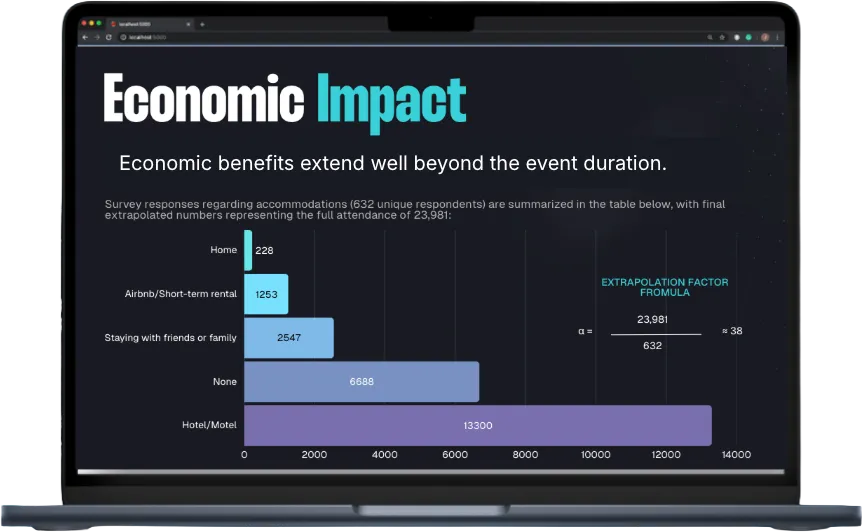
Fastbreak Pulse was built for that specific problem. Rather than estimating impact after an event ends, it captures verified attendee data on the ground while the event is happening, through on-site ambassadors, mobile surveys, and direct engagement with the families who showed up. The result is a report that reflects what actually happened, not what a model predicted.
- Where attendees came from and where they spent: Real travel origin data and local spending patterns, not regional estimates.
- What they thought of the experience: First-party survey data collected on-site, with results available quickly after the event ends.
- A report built for stakeholders: Clear, visual economic impact reporting that holds up in a budget meeting or an event bid presentation.
- Coverage across every event: The same process scales from a marquee championship to a community weekend tournament without adding work to your team.
For commissions trying to justify funding, win future event bids, or build stronger relationships with event organizers, that difference matters. A number you can defend is worth more than a number that sounds impressive.
Final Thoughts
Every destination that hosts a FIFA World Cup match or a Super Bowl-adjacent event in 2026 will benefit from elevated visibility. But the cities that turn 2026 into a long-term sports tourism advantage are the ones using this moment to build infrastructure, relationships, and data capabilities that outlast the marquee events.
The families driving four hours to a youth lacrosse tournament in August won't make the highlights. But they'll be back in March, and June, and October, year after year, compounding into an economic asset.
The question worth asking now is whether your organization has the tools to measure what those visits are worth, tell that story credibly, and use it to grow.
Fastbreak Pulse gives sports commissions and visitor bureaus the data to tell that story. First-party attendee data, economic impact reporting, and stakeholder-ready reports, all captured on the ground at your events without adding work to your team.
The game is being played in every city, every weekend. The question is whether you can prove it. Talk to the Fastbreak Pulse team to learn more.


